Vista Digital Mixing System
1-12 Introduction SW V3.3 Date printed: 05.08.03
Locking a Bay: It is possible to prevent one or more bays from scrolling by switching the
SCROLL: LOCK BAY key on the corresponding bay ON. This will make
that bay isolated from the remaining sections. It doesn't only lock from
scrolling, but also all global view changes on the surface will not influence
locked bays. However, it is possible to change views on a locked bay by
operating its GLOBAL VIEW keys. These will now only influence the locked
bay. A locked bay is strictly isolated from view changes and will operate
independently.
Please note that it is also possible to scroll a locked bay independently by
using the arrow keys on that specific bay.
It is possible as well to lock multiple bays at a time by pressing and hold-
ing the first SCROLL: LOCK BAY key and pressing a second SCROLL: LOCK
BAY key on an other bay; this will lock all bays in between and form a
“lock group”. Multiple bays within a lock group will scroll at a time and
perform common global view changes. In this way it is easy to split the
desk for two-operator use.
Scrolling a Locked Bay by One Section:
When both the SCROLL: SECTION and the SCROLL: LOCK BAY keys are
ON on a fader bay, this is a special case. When pressing one of the arrow
keys on that specific bay, the display of channels will jump by exactly one
section. This function becomes very obvious when looking at the dark
background indication on the Graphic Controller. This operation mode
might be useful for operators who want to change to a different section
with a locked bay.
1.2 The Graphic Controller (GC)
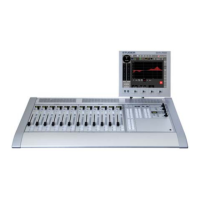
An important feature of the Vista Digital Mixing System is the Graphic
Controller, also referred to as “GC”. The Graphic Controller program is
used for operating all mixing console functions that extend console’s func-
tionality.
Specifically, the Graphic Controller’s extended functions include:
• General and channel-specific router control (defining the order of proc-
essing elements, e.g. EQ or dynamics libraries, within a channel)
• Recall and management of snapshots and cue points
• Saving of desk clipboards
• Assignment of the DSP channels to the fader strips
• Automation control and operation of the timecode control
• Tone generator and metering control
• Control group and linkage control
• Production and Title management
• System administration
Various display windows and dialog boxes logically group the individual
functions. Visual elements are optimized for simple and intuitive operation.
With the help of an easy-to-understand General Patch page, the setup of
router cross points is dramatically simplified, even for large mixing con-
sole configurations. Via a Snapshot window, all mixing console parameters
can be stored and recalled using mouse clicks. Some of the most important
functions are also available as dedicated keys on Vista’s control bay. In the
pull-down AutoTouch+ dynamic automation window, all timecode, loop
points, and mix passes can be controlled easily and intuitively.



 To Next Page