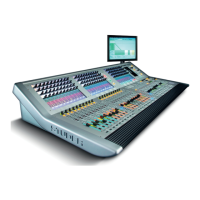
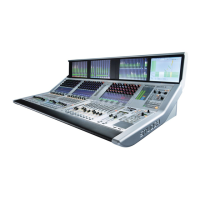
Vista Digital Mixing System
Date printed: 05.08.03 SW V3.3 Parameters 3-45
• User – When this mode is selected, the panning algorithms are estab-
lished from the Microphone User Settings interface provided under the
main Option menu in the system Graphic Controller. The settings made
affect the relationship between amplitude and time differences, deter-
mined by the settings of the imaginary microphones. This will be de-
scribed later.
Room Size (RSiz) This sets the apparent room size that will determine the impulse response
generated by the VSP channel. The settings range from 0 to 31. The 0 set-
ting results in an impulse response that is around 40 ms long and the high-
est setting corresponds to a response where the longest reflection is around
200 ms. Note that this only affects the discrete reflection patterns. The late
reflections are controlled within the Reverb Channel.
Room Diffusion (RDif) Diffusion controls the spreading of the reflections over time. If the discrete
reflections are too apparent, adding some diffusion will smear them over
time. The amount of diffusion should be set in accordance with the ab-
sorption control (as described later). A highly damped room accepts higher
diffusion, without sounding colored. The nominal setting is 50%.
Room Focus (RFoc) Focus controls the gains of the reflections depending on their distribution
in time. A high focus (+12 dB) boosts the early discrete reflections which
are located around the originating source (like on a stage) and creates a fo-
cusing effect. A low focus setting (–12 dB) causes a defocusing since the
late discrete reflections are emphasized. Since these usually come from the
back, the sound will appear to be coming from all directions when the Fo-
cus control is turned down.
Reverb Send (RSnd) The Reverb Send controls the amount of the signal that is being sent to the
Reverb Bus or Buses for this VSP panner. The default level is full OFF.
By adjusting this control, the audio source for this channel may be made to
be more “wet” or “dry”.
Absorption (ABSN) By changing this control, the high-frequency content of the reflections can
be adjusted (similar to a HF roll-off). With the control set to 1%, the sound
will be very bright, as if the walls were tile or marble. With the control at
100%, the reflections will be muffled, as if the walls were covered with
carpet.
Ambiance (AMBI) The Ambiance control changes the balance between the direct sound and
the indirect sound (i.e., the reflections). When the control is at 1% there
will only be direct sound. With the control at 100% there will only be re-
flected sound. So with this control you can affect how much of the room is
“heard”. The switch next to the Ambiance control turns the room ambiance
on and off. When the switch is off, no reflected, but only direct sound will
be heard.
Distance (DIST) This control adjusts the relative perceived distance of the sound source, by
adjusting the reflections. It works in conjunction with the panner controls
so that it only has effect if the panner has the sound source panned to an
extreme location (on the perimeter of the panning circle). So if the distance
control is to be active, at least one panner control must be set away from
its centered position (or the joystick must be positioned at an edge). The
switch next to the distance control selects one of two distance modes.
When the switch is OFF, the normal mode is active. When the switch is
ON, the Film distance mode is active. When Film mode is active the dis-
tance parameter also lowers the audio level as the audio source is set for
more distance. This is a realistic effect useful in mix-to-picture applica-
tions. In a music mix (with Film mode off), the level would want to remain
constant even as the distance perception is increased, so direct sound is
decreased while a power normalizer maintains a constant audio level.



 To Next Page