Chapter 6: I/O Features in Cyclone IV Devices 6–15
Termination Scheme for I/O Standards
March 2016 Altera Corporation Cyclone IV Device Handbook,
Volume 1
Differential I/O Standard Termination
Differential I/O standards typically require a termination resistor between the two
signals at the receiver. The termination resistor must match the differential load
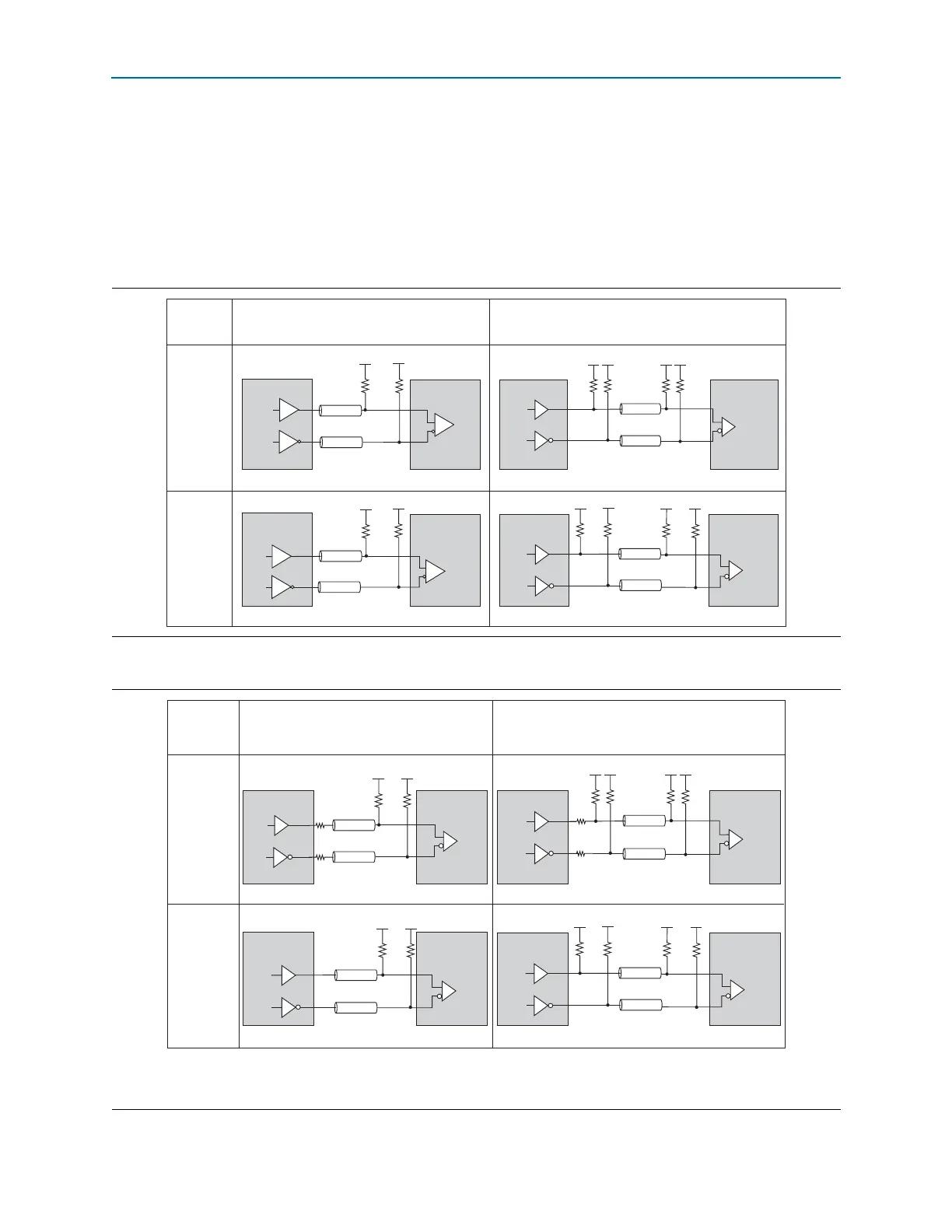
impedance of the bus (refer to Figure 6–7 and Figure 6–8).
Cyclone IV devices support differential SSTL-2 and SSTL-18, differential HSTL-18,
HSTL-15, and HSTL-12, PPDS, LVDS, RSDS, mini-LVDS, and differential LVPECL.
Figure 6–7. Cyclone IV Devices Differential HSTL I/O Standard Class I and Class II Interface and Termination
External
On-Board
Termination
OCT
Transmitter
Receiver
V
TT
V
TT
Transmitter
Receiver
V
TT
V
TT
Cyclone IV Device
Family Series OCT
50
Ω
Differential HSTL Class ITermination
Differential HSTL Class II
Transmitter Receiver
50 Ω
50 Ω 50 Ω
50 Ω
V
TT
V
TT
50 Ω 50 Ω
V
TT
V
TT
Transmitter
Receiver
50
Ω
50Ω 50 Ω
50 Ω
V
TT
V
TT
50 Ω 50 Ω
V
TT
V
TT
Cyclone IV Device
Family Series OCT
25
Ω
50 Ω
50 Ω
50 Ω
50 Ω
50 Ω 50 Ω
50 Ω 50 Ω
Figure 6–8. Cyclone IV Devices Differential SSTL I/O Standard Class I and Class II Interface and Termination
(1)
Note to Figure 6–8:
(1) Only Differential SSTL-2 I/O standard supports Class II output.
Differential SSTL Class I Differential SSTL Class II
External
On-Board
Termination
OCT
Transmitter Receiver
50 Ω
50 Ω 50 Ω
50Ω
V
TT
V
TT
25 Ω
25 Ω
Transmitter Receiver
50 Ω
50 Ω 50 Ω
50 Ω
V
TT
V
TT
25 Ω
25 Ω
50 Ω 50 Ω
V
TT
V
TT
Transmitter
Receiver
50 Ω
50Ω 50 Ω
50 Ω
V
TT
V
TT
50 Ω 50 Ω
V
TT
V
TT
Cyclone IV Device
Family Series OCT
25
Ω
Transmitter Receiver
50 Ω
50 Ω 50 Ω
50 Ω
V
TT
V
TT
50
Ω
Cyclone IV Device
Family Series OCT
Termination



 To Next Page