Chapter 2: Logic Elements and Logic Array Blocks in Cyclone IV Devices 2–3
LE Operating Modes
November 2009 Altera Corporation Cyclone IV Device Handbook,
Volume 1
In addition to the three general routing outputs, LEs in an LAB have register chain
outputs, which allows registers in the same LAB to cascade together. The register
chain output allows the LUTs to be used for combinational functions and the registers
to be used for an unrelated shift register implementation. These resources speed up
connections between LABs while saving local interconnect resources.
LE Operating Modes
Cyclone IV LEs operate in the following modes:
■ Normal mode
■ Arithmetic mode
The Quartus
®
II software automatically chooses the appropriate mode for common
functions, such as counters, adders, subtractors, and arithmetic functions, in
conjunction with parameterized functions such as the library of parameterized
modules (LPM) functions. You can also create special-purpose functions that specify
which LE operating mode to use for optimal performance, if required.
Normal Mode
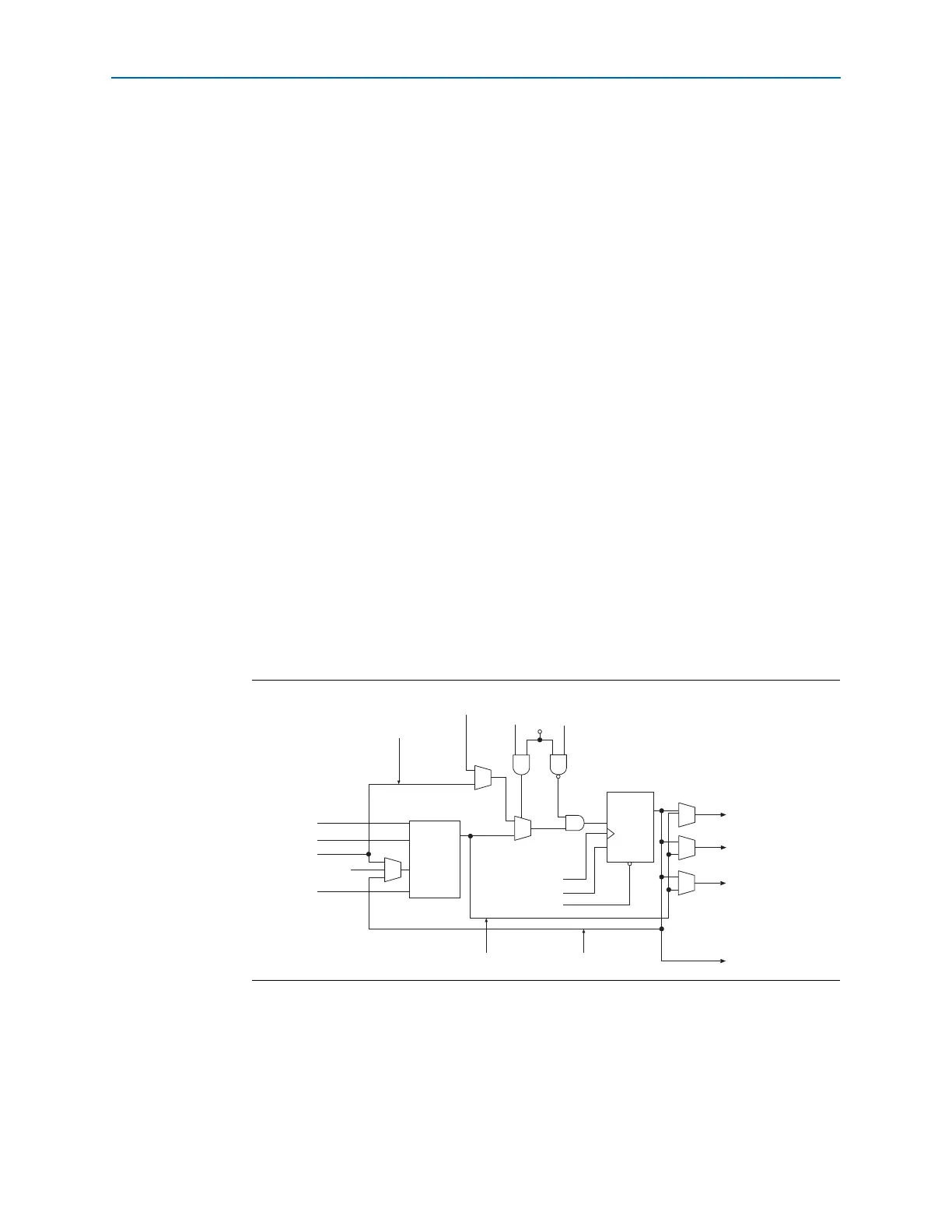
Normal mode is suitable for general logic applications and combinational functions.
In normal mode, four data inputs from the LAB local interconnect are inputs to a
four-input LUT (Figure 2–2). The Quartus II Compiler automatically selects the
carry-in (
cin
) or the
data3
signal as one of the inputs to the LUT. LEs in normal mode
support packed registers and register feedback.
Figure 2–2 shows LEs in normal mode.
Figure 2–2. Cyclone IV Device LEs in Normal Mode
data1
Four-Input
LUT
data2
data3
cin (from cout
of previous LE)
data4
clock (LAB Wide)
ena (LAB Wide)
aclr (LAB Wide)
CLRN
D
Q
ENA
sclear
(LAB Wide)
sload
(LAB Wide)
Register Chain
Connection
Register
Chain Output
Row, Column, and
Direct Link Routing
Row, Column, and
Direct Link Routing
Local Routing
Register Bypass
Packed Register Input
Register Feedback



 To Next Page