Chapter 8: Configuration and Remote System Upgrades in Cyclone IV Devices 8–45
Configuration
May 2013 Altera Corporation Cyclone IV Device Handbook,
Volume 1
JTAG Configuration
JTAG has developed a specification for boundary-scan testing (BST). The BST
architecture offers the capability to efficiently test components on PCBs with tight
lead spacing. The BST architecture can test pin connections without using physical
test probes and capture functional data while a device is normally operating. You can
also use the JTAG circuitry to shift configuration data into the device. The Quartus II
software automatically generates .sof for JTAG configuration with a download cable
in the Quartus II software Programmer.
f For more information about the JTAG boundary-scan testing, refer to the JTAG
Boundary-Scan Testing for Cyclone IV Devices chapter.
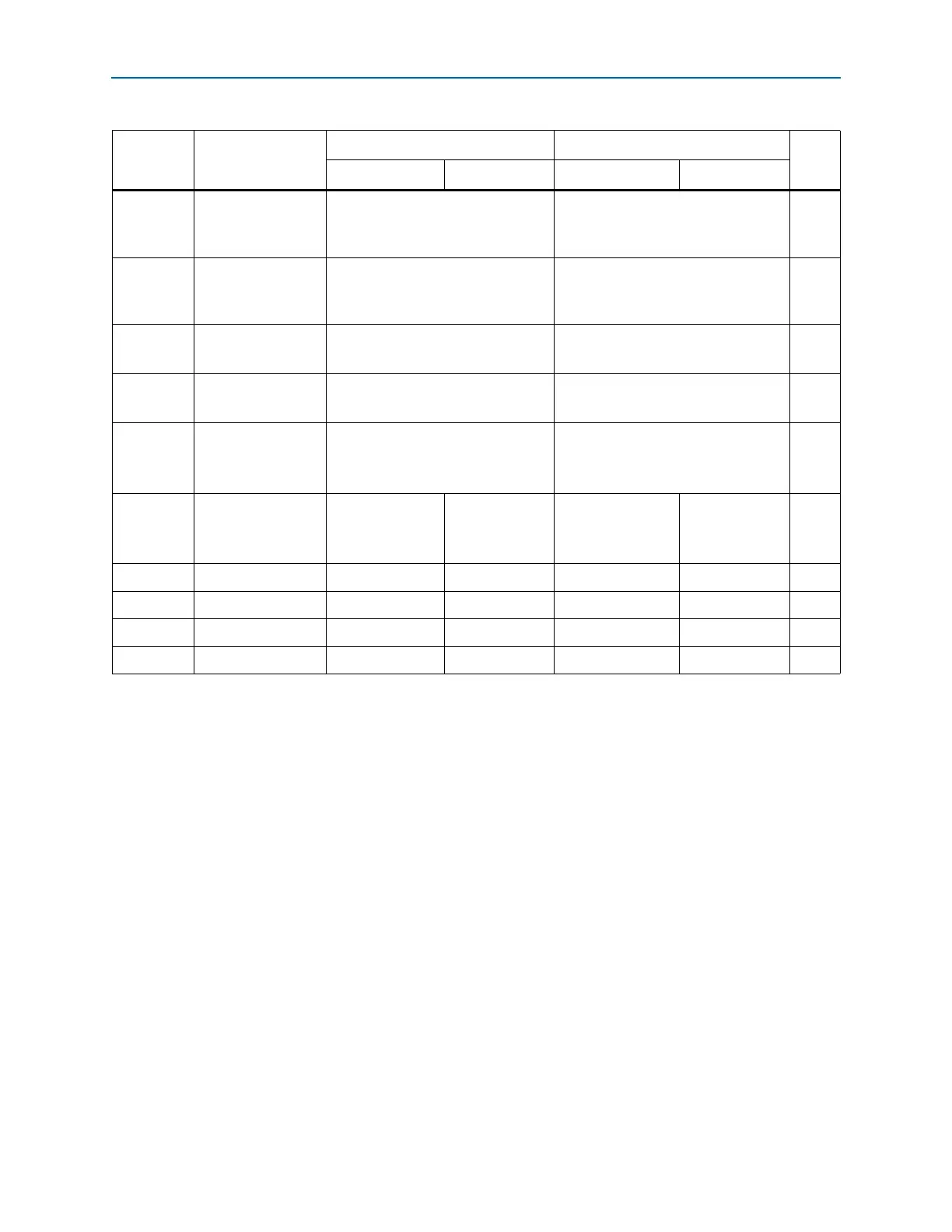
t
ST2CK
nSTATUS
high to
first rising edge of
DCLK
2—µs
t
DH
Data hold time after
rising edge on
DCLK
0—ns
t
CD2UM
CONF_DONE
high to
user mode
(5)
300 650 µs
t
CD2CU
CONF_DONE
high to
CLKUSR
enabled
4 × maximum
DCLK
period — —
t
CD2UMC
CONF_DONE
high to
user mode with
CLKUSR option on
t
CD2CU
+ (3,192 ×
CLKUSR
period)
——
t
DSU
Data setup time
before rising edge
on
DCLK
58——ns
t
CH
DCLK
high time 3.2 6.4 — — ns
t
CL
DCLK
low time 3.2 6.4 — — ns
t
CLK
DCLK
period 7.5 15 — — ns
f
MAX
DCLK
frequency
(6)
— — 133 66 MHz
Notes to Table 8–13:
(1) Applicable for Cyclone IV GX and Cyclone IV E with 1.2-V core voltage.
(2) Applicable for Cyclone IV E with 1.0-V core voltage.
(3) This value is applicable if you do not delay configuration by extending the
nCONFIG
or
nSTATUS
low pulse width.
(4) This value is applicable if you do not delay configuration by externally holding the
nSTATUS
low.
(5) The minimum and maximum numbers apply only if you choose the internal oscillator as the clock source for starting the device.
(6) Cyclone IV E devices with 1.0-V core voltage have slower F
MAX
when compared with Cyclone IV GX devices with 1.2-V core voltage.
Table 8–13. FPP Timing Parameters for Cyclone IV Devices (Part 2 of 2)
Symbol Parameter
Minimum Maximum
Unit
Cyclone IV
(1)
Cyclone IV E
(2)
Cyclone IV
(1)
Cyclone IV E
(2)



 To Next Page