S820E UG PN: 10580-00343 Rev. H 9-5
High Accuracy Power Meter 9-3 General Measurement Setup Connection
Connection and Offset
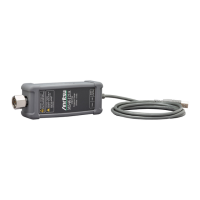
1. Connect the source to be measured to the USB sensor. Use any required
external attenuation or gain so the expected power level is within
specification for the sensor.
2. Press Amplitude then Offset Value. Enter an offset value for any
external attenuation (negative value) or external gain (positive value).
The displayed power is adjusted by the offset value.
As an example, a power source around 1 Watt (30 dBm) may cause
damage to some sensors. 10 dB of in-line external attenuation will
bring the power level down to approximately 100 mW, within the
sensor range. Adding an Offset Value of –10 dB will remove the external
attenuation from the displayed power level resulting in the correct
power value being displayed on the analyzer.
Setting the Measurement Frequency
Press the Frequency main menu key then press Measurement Frequency. Set
the measurement frequency to match the actual signal frequency being
measured by using the number keypad. Then press the unit of measure
button. The USB sensors contain EEPROM correction data for their own
inherent frequency response. Failing to set the measurement frequency
properly degrades measurement accuracy.
Setting the Amplitude
The maximum and minimum values of the analog display can be set in the
Amplitude menu. Relative Power is a useful feature to obtain the power
reading with respect to a previous power level.
1. Press the Amplitude main menu key.
2. Press the Max Value submenu key and set the upper scale value. Press
the Min Value submenu key and set the lower scale value.
or
Press the Autoscale submenu key to adjust the range automatically.
The current power level is centered with Min Value automatically set at
90 % of the current power and Max Value automatically set at 110 % of
the current power. Refer to Figure 9-3 on page 9-6.






 To Next Page