Need help?
Do you have a question about the Minebea Intec X3 and is the answer not in the manual?
Guidance on careful and complete reading of the manual before product use.
Explains signal words (DANGER, WARNING, CAUTION) indicating severity of hazards when safety measures are not followed.
Explains the sequential numbering (1.-n.) and placement of steps in operating instructions.
Explains signal words (DANGER, WARNING, CAUTION) indicating severity of hazards when safety measures are not followed.
Device compliance with safety regulations and user responsibility for safe operation.
Specifies the device's purpose for analysis and weighing, requiring trained personnel.
Details the procedure for repairs and maintenance, emphasizing Minebea Intec involvement.
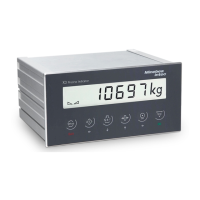
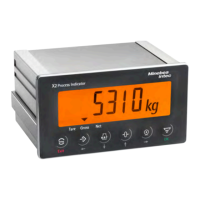
Describes the instrument's 7-segment display, function keys, and two main applications.
Details accuracy, speed, display type, keys, interfaces, and expansion capabilities.
Explains how to operate the indicator using front-panel keys, VNC viewer, or web browser.
Emphasizes reading safety instructions (Ch. 2) and protecting cable connections from damage.
Details connecting screens and equipotential bonding conductor for EMC compliance.
Describes the main electronic components: mainboard and display board.
Provides general information and color codes for connecting analog load cells and platforms.
Lists the function-specific plug-in cards that can accommodate the main board.
Explains data retention during power failure and storage in non-volatile memory.
Outlines methods for device setup via front-panel, VNC, or web browser.
Details how to configure parameters and calibrate the device using front-panel keys.
Provides step-by-step instructions for calibrating the internal weighing point using front-panel keys.
Guides through the calibration process for load cells, including Connexx modules.
States that filling functions are only supported by the 'EasyFill' application.
Explains how to configure production parameters like mode and interaction via front-panel keys.
Details the requirements and procedure for starting the 'EasyFill' application.
Details the requirements and procedure for starting the filling process, including material ID selection.
Describes procedures for testing the display and front-panel keys.
Explains accessing device functions like remote configuration, log files, and screenshots via a web browser.
Provides instructions for updating device software using the FlashIt!32 program.
Explains turning the PR 5410 into a field bus slave and Master/Slave communication.
Details the 8-byte write and read windows for weighing points in the Standard application.
Describes the 64-byte interface for EasyFill, differentiating system and material parameters.
Introduces the SPM (Scratch Pad Memory) for storing data and accessing it via OPC, ModBus, or fieldbus.
Details elementary data types, their bit width, and possible value ranges.
Explains how to address the SPM table using bit and byte addressing (%ML, %MD, %MW, %MB, %MX).
Lists common error messages related to the weighing circuit, their VNC text, and possible causes.
Provides a comprehensive list of general error codes, their display text, and potential causes.
Details environmental specifications like temperature, moisture, protection class, and EMC compliance.
Provides technical specifications for the weighing electronics, including load cells, principle, and accuracy.
Lists spare part numbers and their corresponding designations for replacement.
Lists various certificates like EU Declaration of Conformity and OIML Certificate of Conformity.
 General
| Protection class | IP65 |
|---|---|
| Keypad | 4 keys |
| Interfaces | RS232 |
| Measurement Range | Depending on connected weighing platform |
| Accuracy | Depending on connected weighing platform |
| Output Interface | RS232 |
| Dimensions | 144 mm x 72 mm x 45 mm |
| Weight | 0.3 kg |

 To Next Page