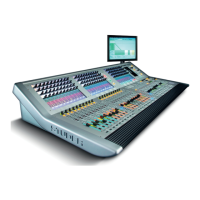
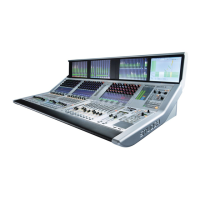
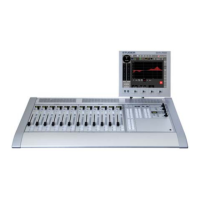
Vista Digital Mixing System
Date printed:26.10.07 SW V3.3/3.5 Application Notes 9-3
9.1 Application Note 1:
Working with Stems on Vista 7
9.1.1 General
Although the Vista 7 mixing console doesn’t provide the classic paddle-
style film monitoring panel, it is well able to cope with mixing situations
where the user wants to mix and record different stems separately, using
the monitoring for adding all stems together in order to check the whole
mix. Since the structure of the console is quite flexible, the solution de-
scribed here may be altered according to specific customer needs.
• Vista 7 will use the group buses to create your stem mixes. The buses
will be patched directly to the corresponding stem recorder, without
master channels in between. The subgroup master channels are only
used for summing your stems, in order to provide the signal for additive
monitoring. If needed, level displays are provided on these subgroup
master channels. Make sure the meter tap point is set to INPUT.
• The master buses are in fact only used for monitoring purposes. There is
no need to have master channels with faders, since it is easily possible
to listen to “bus outputs” by using the flexible monitoring assignment
capabilities.
• In order to listen to the stems, one of the top eight source selectors has
to be configured to listen to “master bus out”. The remaining seven
source selectors are still freely assignable for any of your audio sources.
• The lower half of the 16 monitoring source selectors are used in pairs of
two, controlling one stem each. Therefore we provide fast access to up
to four stems.
• One pair of keys (above each other) provides the functionality to toggle
between “tape send” (bus output) and “tape return” (input to core from
tape). It is also possible to mute a stem by pressing the currently se-
lected input key (send/return) a second time. This will make the key go
dark, and the corresponding stem will be muted.
• Temporary action on stem monitoring is possible, for both muting and
tape send/return switching.
For better understanding, refer to the drawing on the next page.
9.1.2 Stem Monitoring Setup
1 Use the configuration editor to create a console structure as described
above.
- If you use three stems with 5.1 format, configure three sets of six
subgroup buses.
- Configure group master channels without any signal processing.
- Configure master buses (e.g. six for 5.1) without master channels.
2 Patch points from the subgroup buses to their master channels are set
automatically (IN1), but the tape return lines need to be patched manu-
ally to IN2 of the subgroup master channels.
3 Setup up CGM master channels in such a way that each of them con-
trols a set of subgroup master channels, as shown in the drawing.



 To Next Page