2-6 Starling Monitor - User Guide
Theory of Operation
Theory of Operation
In addition to utilizing advanced Bioreactance technology, the theory behind operation of the
Starling system is the use of time delay or phase shifts which occur when an alternating
electrical current is passed through the thorax.
Method of operation is as follows:
Four noninvasive sensor pads are applied to the thorax, creating a ‘box’ around the heart.
A small electric current of known frequency (75kHz) is applied across the thorax between
the outer pair of sensors.
A voltage signal is recorded between the inner pair of sensors.
The flow of blood in the thorax introduces a time delay, or phase shift, in the signal.
Baxter’s proprietary algorithms interpret the signal to provide stroke volume.
These signal changes have been correlated to known thermodilution cardiac output in
65,000 patient samples (Squara,
Intensive Care Med (2007) 33:1191–1194
) across multiple
clinical settings (ICU/OR/Cath Lab).
A set of Starling Sensors are attached to the patient’s body (illustrated in Figure 2-1) and
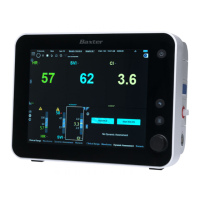
connected to the Starling Monitor (see Figure 2-8).
Each set comprises 8 sensors (2 on each of 4 sensor pads); these perform the following
functions:
4
outer
sensors: emit a low-level electrical current
4
inner
sensors: detect the information and send it back to the Monitor





 To Next Page