©2020 Baxter International Inc. 2-1
Chapter 2 – Starling Monitoring System
Overview
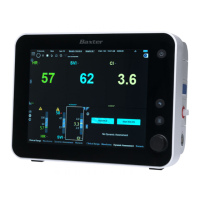
The compact, portable Starling system, with NIBP and SpO
2
functionalities, is suitable for use
in any Emergency Department (ED), Intensive Care Unit (ICU) or Operating Room (OR) by
physicians and nurses, or by a Rapid Response team.
Utilizing patented Bioreactance technology, the computer-controlled Starling Monitor
provides continuous, accurate, non-invasive monitoring of a range of hemodynamic
parameters that are important for volume management and perfusion optimization.
In many diagnostic scenarios, the clinician must determine whether or not the patient is fluid
responsive. As a guide to this clinical decision-making, features incorporated in the easy-to-
use Starling system include:
Display of key hemodyanamic parameters - such as
Stroke Volume Index (SVI)
,
Cardiac Index
(CI)
and
Total Peripheral Resistance (TPRI)
.
Dynamic Assessment Reports - highlight the change in SVI in response to a fluid challenge
(PLR or Fluid Bolus), presented as an indicator on the Frank-Starling curve.
Continuous monitoring of all hemodynamic variables.
Additional module options (NIBP and SpO
2
).
Compatibility with Philips Patient Monitors and GE Patient Monitors
(approved by
Cheetah Medical for use with the Starling Monitor).





 To Next Page