4–24 Altera Corporation
Stratix Device Handbook, Volume 2 June 2006
Stratix & Stratix GX I/O Banks
Non-Voltage-Referenced Standards
Each Stratix I/O bank has its own VCCIO pins and supports only one
V
CCIO
, either 1.5, 1.8, 2.5 or 3.3 V. A Stratix I/O bank can simultaneously
support any number of input signals with different I/O standard
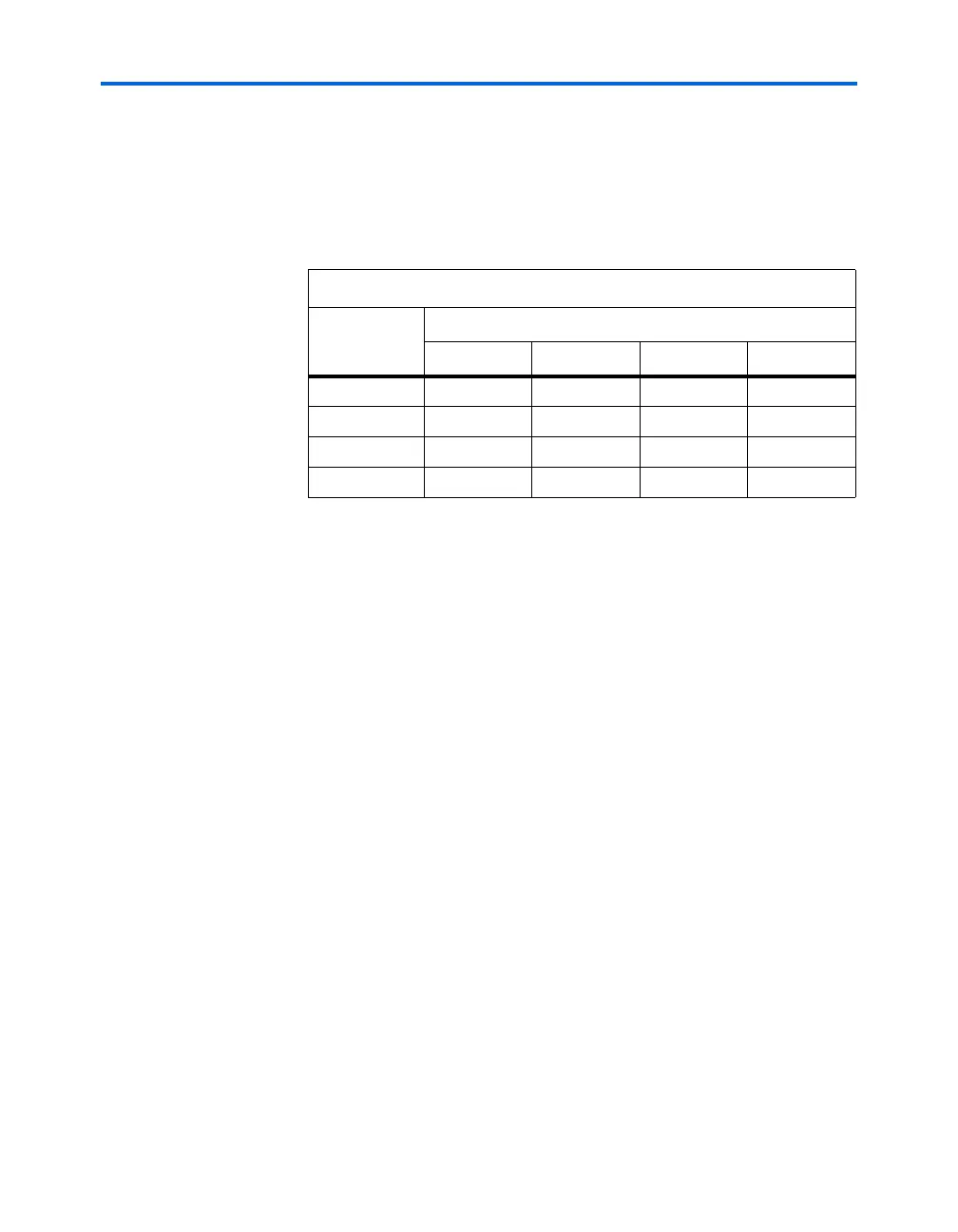
assignments, as shown in Table 4–5.
For output signals, a single I/O bank can only support non-voltage-
referenced output signals driving at the same voltage as V
CCIO
. A Stratix
I/O bank can only have one V
CCIO
value, so it can only drive out that one
value for non-voltage referenced signals. For example, an I/O bank with
a 2.5-V V
CCIO
setting can support 2.5-V LVTTL inputs and outputs,
HyperTransport technology inputs and outputs, and 3.3-V LVCMOS
inputs (not output or bidirectional pins).
1 If the output buffer overdrives the input buffer, you must turn
on the Allow voltage overdrive for LVTTL/LVCMOS option in
the Quartus II software. To see this option, click the Device &
Pin Options button in the Device page of the Settings dialog
box (Assignments menu). Then click the Pin Placement tab in
the Device & Pin Options dialog box.
Voltage-Referenced Standards
To accommodate voltage-referenced I/O standards, each Stratix I/O
bank supports multiple VREF pins feeding a common VREF bus. The
number of available VREF pins increases as device density increases. If
these pins are not used as VREF pins, they can not be used as generic I/O
pins.
Table 4–5. Acceptable Input Levels for LVTTL/LVCMOS
Bank V
CCIO
Acceptable Input Levels
3.3 V 2.5 V 1.8 V 1.5 V
3.3 V vv
2.5 V vv
1.8 V v (2) v (2)
v
v (1)
1.5 V v (2) v (2)
vv
Notes to Ta b le 4 – 5 :
(1) Because the input signal will not drive to the rail, the input buffer does not
completely shut off, and the I/O current will be slightly higher than the default
value.
(2) These input values overdrive the input buffer, so the pin leakage current will be
slightly higher than the default value.


 To Next Page