Altera Corporation 14–5
January 2005 Stratix Device Handbook, Volume 2
Designing with 1.5-V Devices
Linear Voltage Regulators
Linear voltage regulators generate a regulated output from a larger input
voltage using current pass elements in a linear mode. There are two types
of linear regulators available: one using a series pass element and another
using a shunt element (e.g., a zener diode). Altera recommends using
series linear regulators because shunt regulators are less efficient.
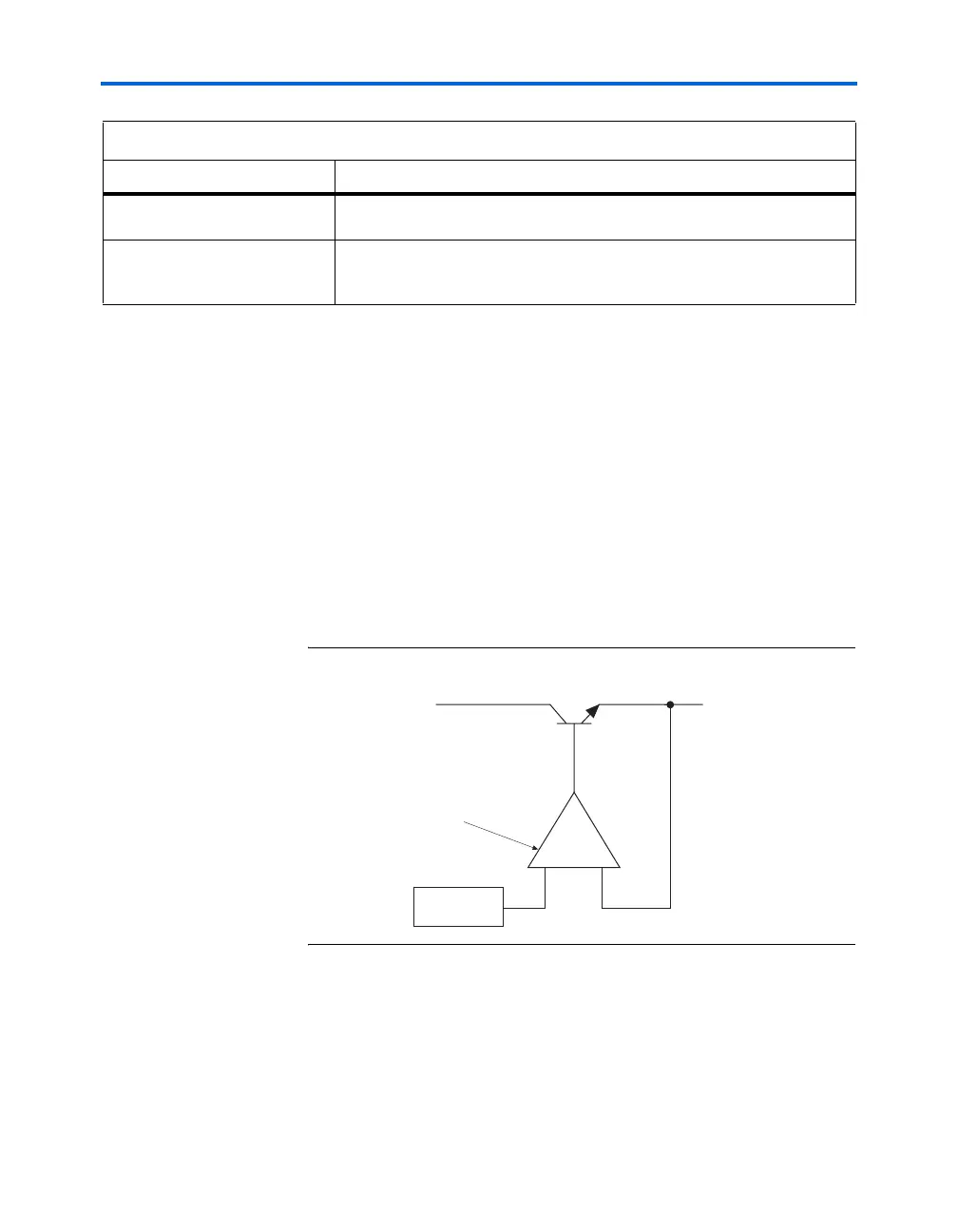
Series linear regulators use a series pass element (i.e., a bipolar transistor
or MOSFET) controlled by a feedback error amplifier (see Figure 14–2) to
regulate the output voltage by comparing the output to a reference
voltage. The error amplifier drives the transistor further on or off
continuously to control the flow of current needed to sustain a steady
voltage level across the load.
Figure 14–2. Series Linear Regulator
Minimum load requirements A minimum load from the voltage divider network is required for good
regulation, which also serves as the ground for the regulator’s current path.
Efficiency Efficiency is the division of the output power by the input power. Each
regulator model has a specific efficiency value. The higher the efficiency
value, the better the regulator.
Table 14–2. Voltage Regulator Specifications & Terminology (Part 2 of 2)
Specification/Terminology Description
–
+
Reference
Error
Amplifier
V
OUT
V
IN



 To Next Page