EM500 Open-Loop Vector Control Inverter User Manual
18
1.2.2Control Modes of Inverter
Control modes of inverter refer to what kind of method is adopted to drive motor at
desired speed or torque. These modes include:
VVF (Vector decoupling based VF control): The steady performance is the same as
that in SVC. Suitable for occasions of low speed change and low speed stability
accuracy and meet the needs of most AC motor drives.
SVC (Sensorless Vector Control): Advanced speed estimate algorithm, no need for
encoder, open loop vector control and high control accuracy.
1.2.3Setting Modes of Inverter
Setting mode of inverter refers to what kind of physical quantity is taken as the
control object when inverter drives motor.
Speed setting mode: Motor speed is taken as the control object;
This mode can be realized by numeric setting, analog input setting, high-speed pulse
input setting, communication setting, digital potentiometer setting, process PID, simple
PLC or preset speed, individually or jointly. In Figure 1-1 to Figure 1-4, various input
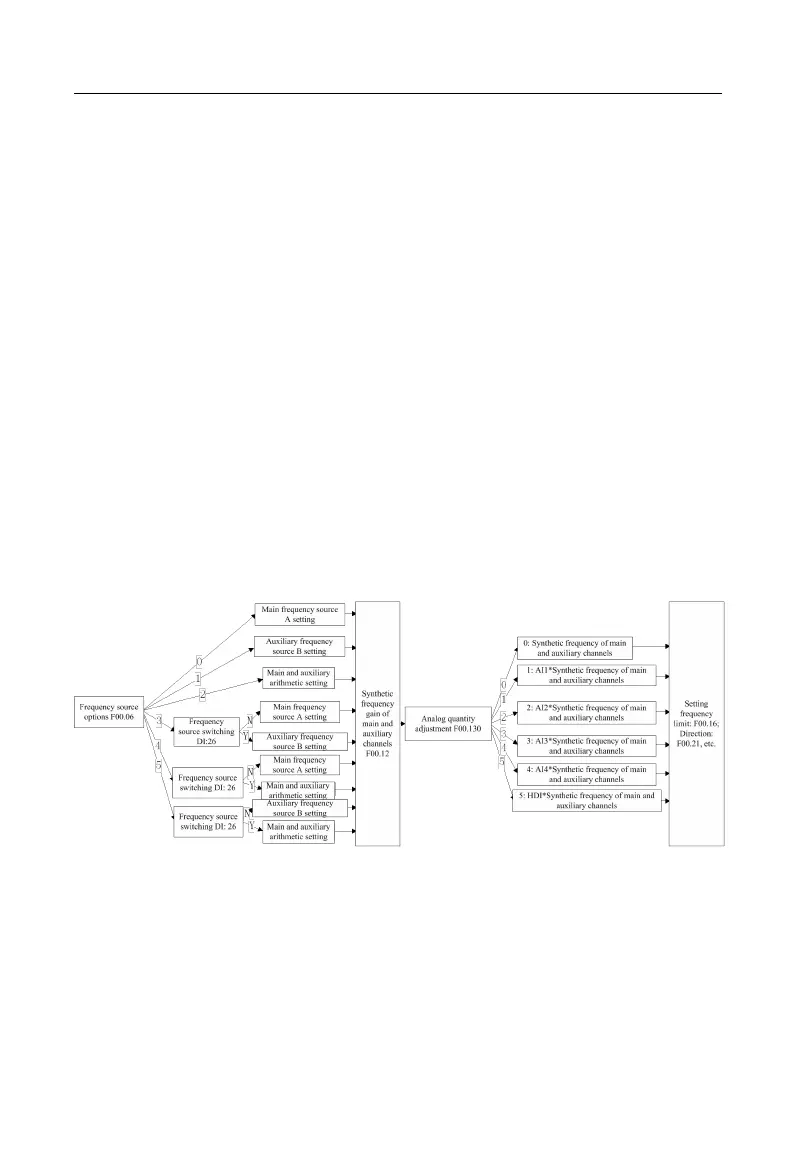
modes under the speed setting mode of EM500 are described:
Figure 1-1 Speed Input Mode
As indicated in Figure 1-1, there are mainly three speed setting modes of EM500,
respectively main frequency source A setting (referred to as “Main A” for short),
auxiliary frequency source B setting (referred to as “Auxiliary B” for short) and main &
auxiliary arithmetic setting. The speed setting mode is finalized by simple regulation and



 To Next Page