EM500 Open-Loop Vector Control Inverter User Manual
294
that the duty ratio is 1)
Energy consumption brake is a brake method by transforming the electric energy
generated during the speed reduction into the heat energy of the braking resistor to realize
rapid brake. It applies to the brake of large inertia or occasions requiring rapid brake and
stop. User needs to choose proper braking resistor and braking unit. See 11.1 Braking
Resistor and 11.2 Braking Unit.
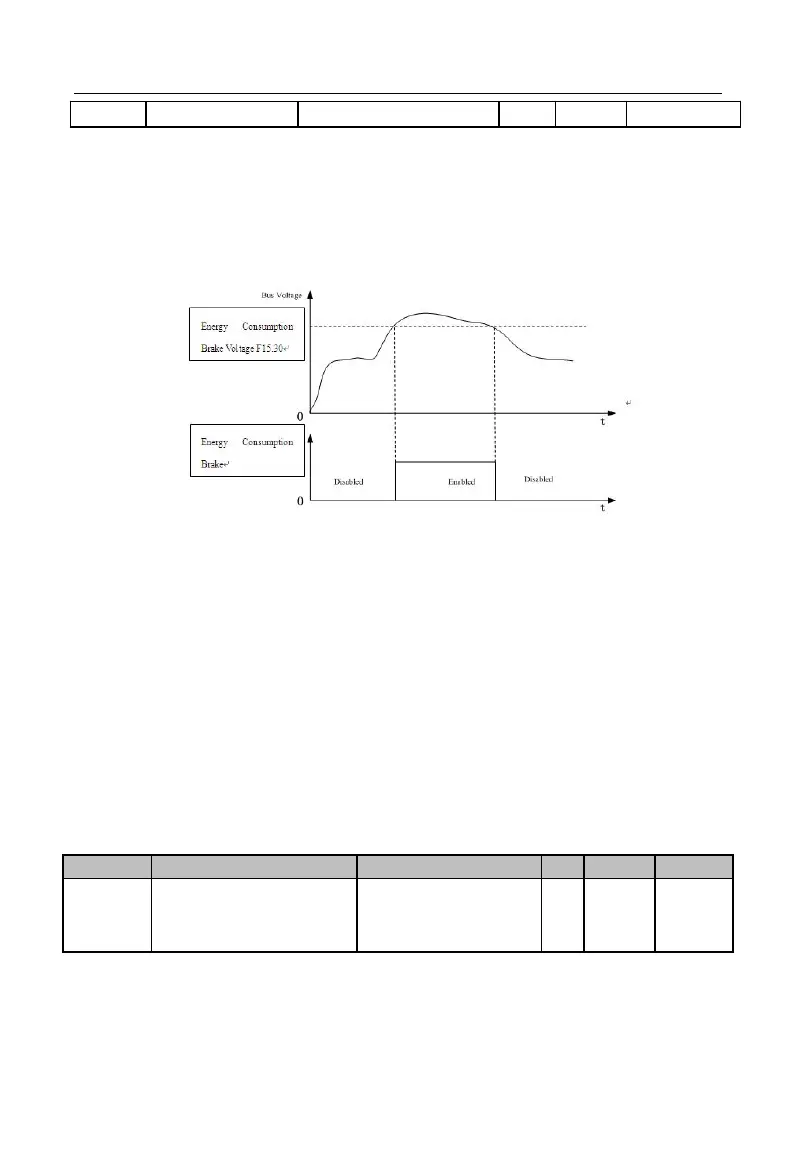
Figure 7-39 Energy consumption brake
As indicated in Figure 7-39, when Energy consumption brake is enabled (F15.30=1)
and bus voltage is greater than the operation voltage of Energy consumption brake
(F15.31), Energy consumption brake starts; when bus voltage drops to a value below a
certain value, Energy consumption brake is disabled.
When inverter is in energy consumption brake, IGBT in the braking unit is on and
the energy can be discharged rapidly through braking resistor. Brake duty ratio (F15.32)
describes the duty ratio when IGBT is on. The higher the duty ratio is, the higher the
brake level will be.
Control Mode of Set
Frequency Lower Than
Lower Limit Frequency
0: Run at Lower Limit
Frequency
1: Stop
When the set frequency of inverter is lower than the lower limit frequency (F00.19),
the control mode can be set through F15.33



 To Next Page