Altera Corporation 5–33
July 2005 Stratix Device Handbook, Volume 2
High-Speed Differential I/O Interfaces in Stratix Devices
t
FALL
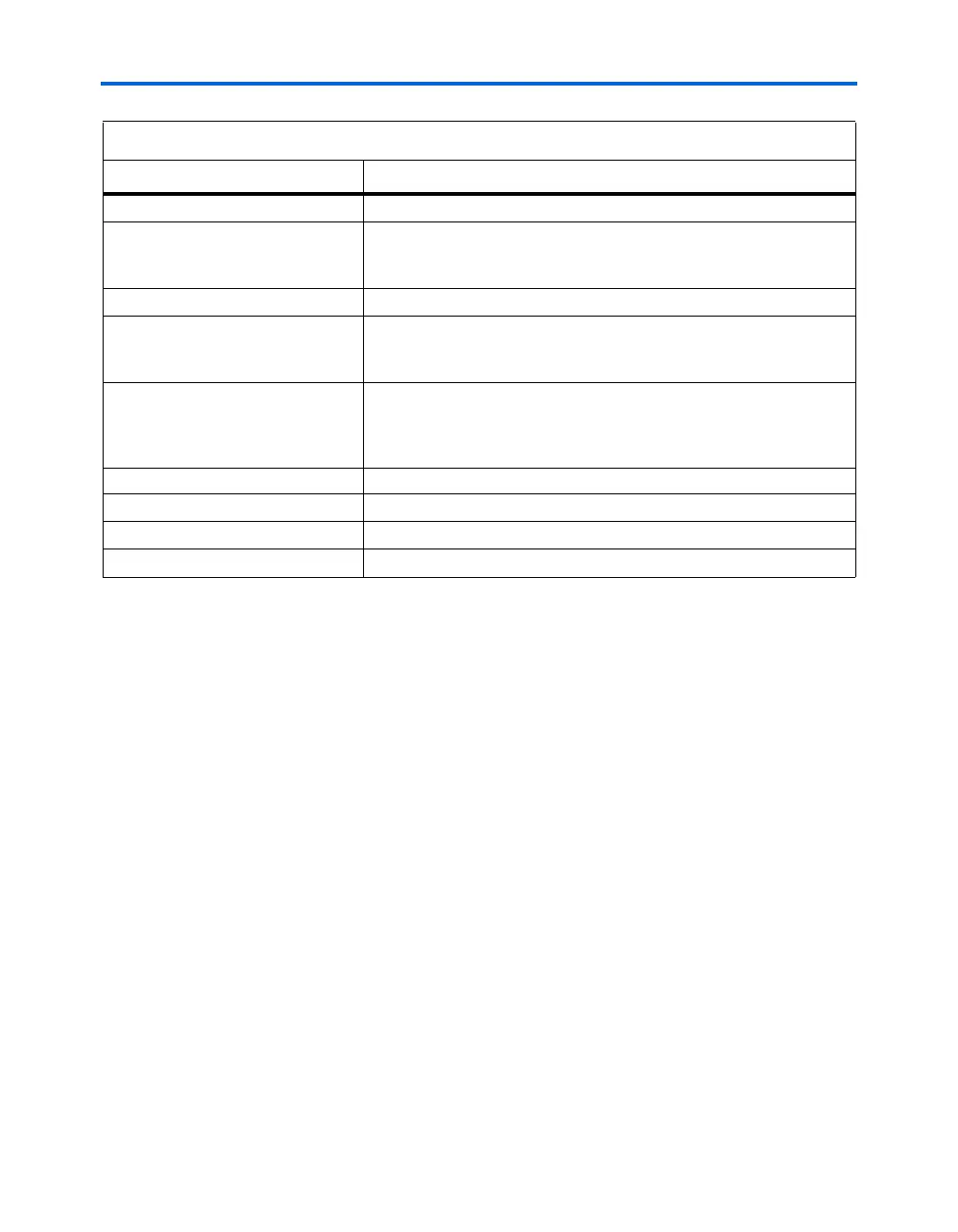
High-to-low transmission time.
Timing unit interval (TUI) The timing budget allowed for skew, propagation delays, and data
sampling window. (TUI = 1/(Receiver Input Clock Frequency ×
Multiplication Factor) = t
C
/w).
f
HSDR
Maximum LVDS data transfer rate (f
HSDR
= 1/TUI).
Channel-to-channel skew (TCCS) The timing difference between the fastest and slowest output edges,
including t
CO
variation and clock skew. The clock is included in the TCCS
measurement.
Sampling window (SW) The period of time during which the data must be valid in order for you to
capture it correctly. The setup and hold times determine the ideal strobe
position within the sampling window.
SW = t
SW
(max) – t
SW
(min).
Input jitter (peak-to-peak) Peak-to-peak input jitter on high-speed PLLs.
Output jitter (peak-to-peak) Peak-to-peak output jitter on high-speed PLLs.
t
DUTY
Duty cycle on high-speed transmitter output clock.
t
LOCK
Lock time for high-speed transmitter and receiver PLLs.
Table 5–6. High-Speed Timing Specifications & Terminology (Part 2 of 2)
High-Speed Timing Specification Terminology



 To Next Page