EMC
VI-13
VI.3 Interval Measurements
With respect to intervals, the global QT interval is measured from the global QRS onset to the global T end. On the
other hand, because the P onset is taken as being simultaneous in all 12 leads, the global PR interval measurement
is from the P onset to the global QRS onset.
VI.4 Stability of Measurements against Noise
Acceptance of minimum waves
The labelling of the QRS waveforms depends by definition (since Einthoven) on the first detected wave. A tiny
positive wave at QRS beginning is called r or R and may mask a true, following Q wave. Therefore the acceptance
criteria of initial waveforms should be clearly defined and standardized。
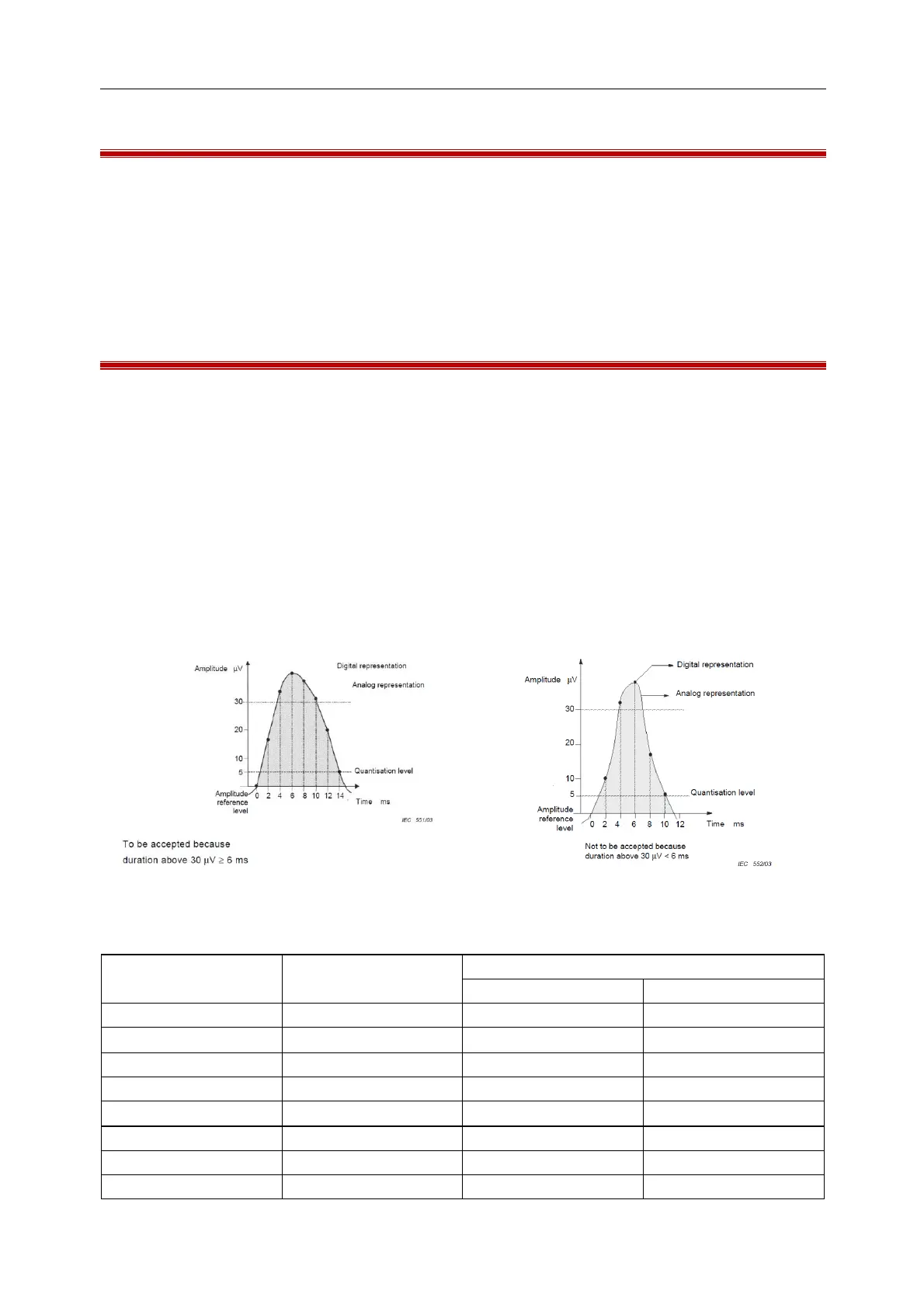
the following rule for acceptance of minimum waves is used:
a) the signal part under consideration shows clearly two opposite slopes with at least one turning point in
between;
b) the signal part under consideration deviates at least 30 μV from the reference level for a duration of at least 6
ms (see Figures 6 and GG);
c) this results in acceptance criteria for minimum waves with observable durations of about 12 ms and amplitudes
≥30 μV.



 To Next Page