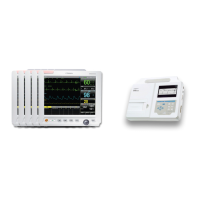
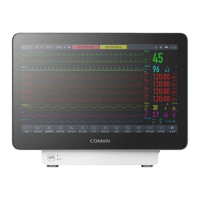
patient monitor for minute-to-minute clinical decision-making.
The accuracy of R on T detection might be compromised on a patient with implantable cardiac
defibrillator or pacemaker.
Patients with intermittent ventricular pacing often trigger false ventricular alarms, especially when the
nurse has neglected to activate the Pace Mode feature.
The atrial fibrillation detection is not intended for pediatric and neonate patients.
A complete and reliable ECG signal input is the basis for arrhythmia analysis and arrhythmia alarm. The
ECG signal quality and the setting of arrhythmia threshold will affect the sensitivity of arrhythmia
detection and heart rate calculation. At least a 5-lead ECG cable is recommended for monitoring, and
12-lead ECG cable is favorable.
The amplitude of the ECG waveform and the setting of QRS threshold will affect the sensitivity of
arrhythmia detection and heart rate calculation.
If the QRS amplitude is too low the Monitor may fail to calculate the heart rate, or detect incorrect
asystole.
During ECG relearning the arrhythmia defection function may not be available. Therefore, the patient
should be closely monitored during and within a few minutes after the ECG relearning.
If Run PVCs and PVCs/min High are detected and alarming the clinician is called to monitor for frequent
PVC’s and deterioration to more serious rhythms.
8.5.2 Arrhythmic Events
This section lists all arrhythmic events that can be detected by the Monitor and their criteria.
8.5.2.1 Lethal Arrhythmia
No QRS complex detected within the set time interval in the absence of ventricular
fibrillation or chaotic signal.
A fibrillatory wave lasting for 6 consecutive seconds, or a dominant rhythm of adjacent
PVCs and the ventricular rate is greater than the V-tach rate limit.
The number of sustained PVCs is greater than or equal to the limit of V-Tach PVCs, and
ventricular rate is greater than or equal to the limit of V-Tach rate.
The number of sustained PVCs is greater than or equal to sustained ventricular
bradycardia threshold, and ventricular heart rate is below the ventricular bradycardia



 To Next Page