800 MHz to 2.7 GHz
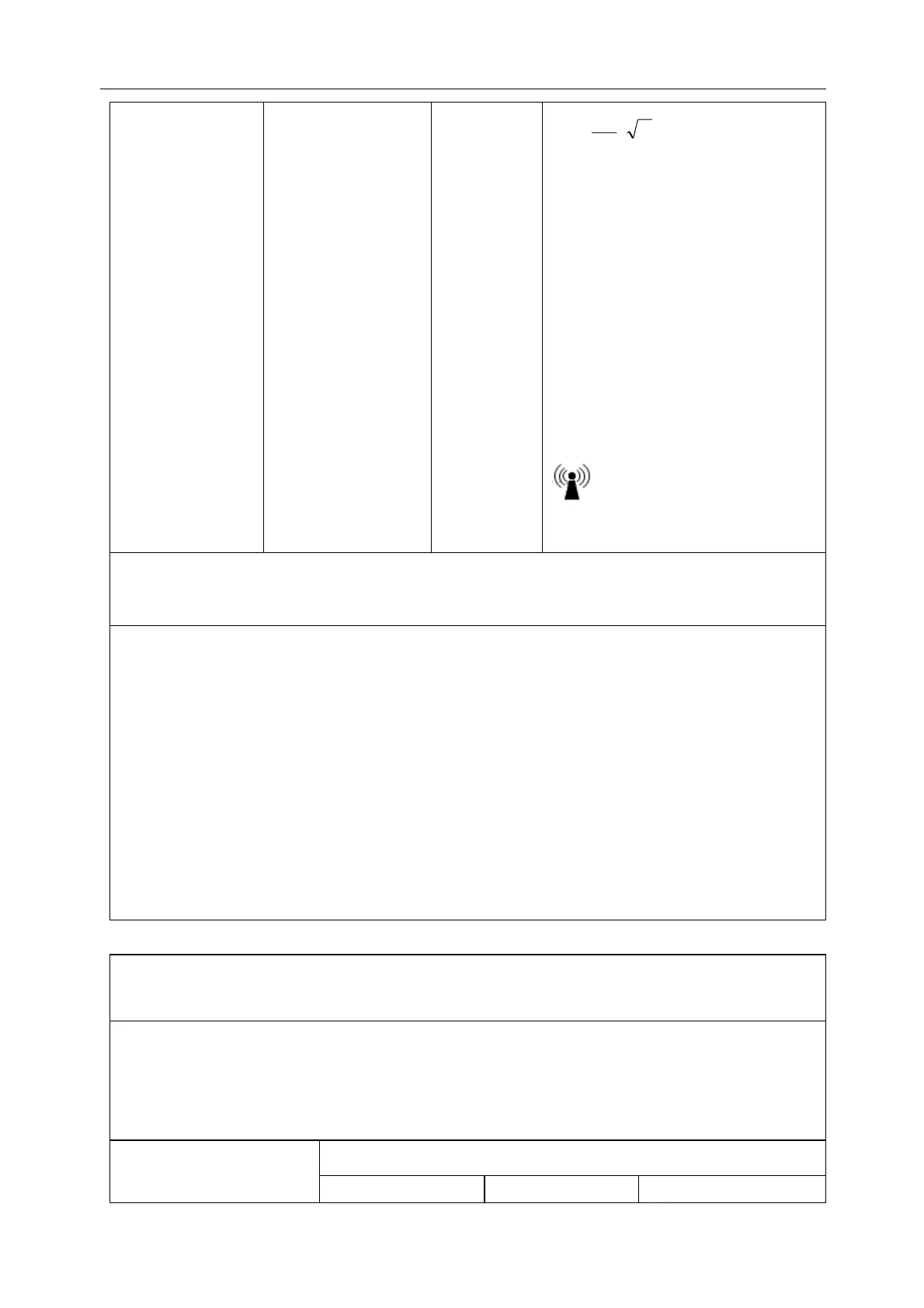
where P is the maximum output power
rating of the transmitter in watts (W)
according to the transmitter manufacturer
and d is the recommended separation
distance in meters (m)
The field intensity of fixed RF transmitters
is measured by surveying
a
the
electromagnetic field and should be lower
than the compliance level in either
frequency range
b
.
Interference may occur in the vicinity of
equipment marked with the following
symbol:
a Field strengths from fixed RF transmitters, such as base stations for radio (cellular/cordless) telephones
and land mobile radios, amateur radio, AM and FM radio broadcast and TV broadcast cannot be
predicted theoretically with accuracy. To assess the electromagnetic environment due to fixed RF
transmitters, an electromagnetic site survey should be considered. If the measured field strength in the
location in which the monitor are used exceeds the applicable RF compliance level above, the monitor
should be observed to verify essential performance. This equipment may cause radio interference or may
disrupt the operation of nearby equipment. If anything abnormal occurs, it may be necessary to take
mitigation measures, such as re-orienting or relocating the equipment or shielding the location.
b. The ISM (industrial, scientific and medical) bands between 0,15 MHz and 80 MHz are 6,765 MHz to 6,795
MHz; 13,553 MHz to 13,567 MHz; 26,957 MHz to 27,283 MHz; and 40,66 MHz to 40,70 MHz. The amateur radio
bands between 0,15 MHz and 80 MHz are 1,8 MHz to 2,0 MHz, 3,5 MHz to 4,0 MHz, 5,3 MHz to 5,4 MHz, 7 MHz
to 7,3 MHz, 10,1 MHz to 10,15 MHz, 14 MHz to 14,2 MHz, 18,07 MHz to 18,17 MHz, 21,0 MHz to 21,4 MHz,
24,89 MHz to 24,99 MHz, 28,0 MHz to 29,7 MHz and 50,0 MHz to 54,0 MHz



 To Next Page