3.
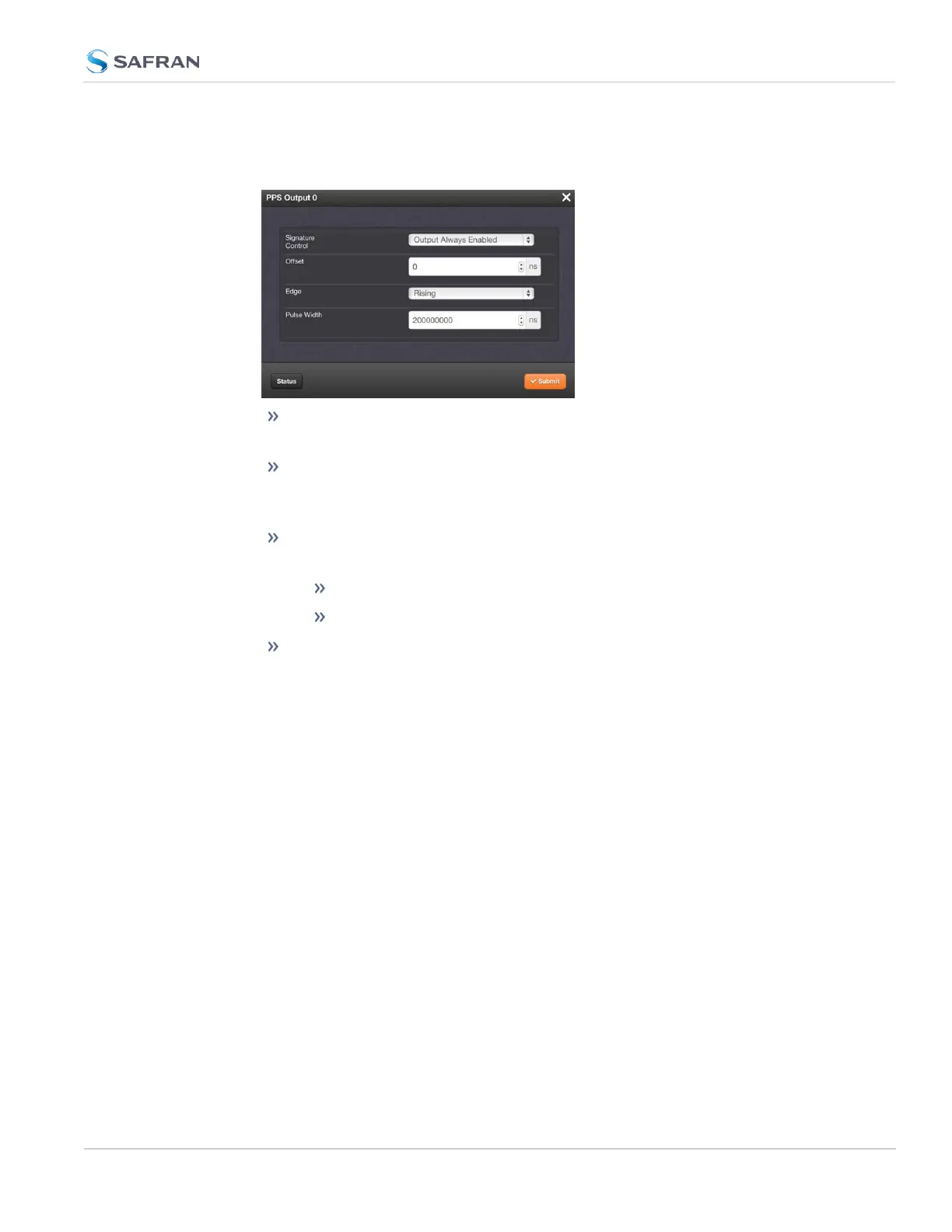
The 1PPS Output Edit window will display, allowing the following items to be
configured:
Signature Control: Determines when the output is enabled. For more
information, see "Signature Control" on page183.
Offset [ns]: Allows to offset the system's 1PPS on-time point, e.g. to com-
pensate for cable delays and other latencies [range = –500000000 to
500000000ns = ±0.5 s].
Edge: Used to determine if the on-time point of the 1PPS output is the
rising or the falling edge of the signal.
Rising
Falling
Pulse Width [ns]: Configures the Pulse Width of the 1PPS output.
[range = 20 to 900000000 ns = 0.0μs to 0.9 s]
[default = 200 ms]
4. Click Submit.
2.20.3 Configuring the 10 MHz Output
A 10 MHz Output is available on the rear panel of the SecureSync 2400 Time and
Frequency Synchronization System.
To configure the 10 MHz output:
1.
Navigate to INTERFACES > OUTPUTS, or to INTERFACES > OPTIONCARDS
(white on orange).
2.
In the panel on the right, click the GEAR button next to the 10 MHz output
that you want to edit.
3.
The 10 MHz edit window will display. Choose a value from the Signature Con-
trol field drop-down list to determine what SecureSync shall do with the out-
put signal in the event its input reference is lost. For more information, see
"Signature Control" on page183.
2.20 Configuring Outputs
CHAPTER 2 • SecureSync 2400 User Manual Rev. 5.2
171


 To Next Page