Note: Please note that it is not advisable to mark more
than one NTP Peer as Preferred, even though SecureSync
will not prevent you from doing so.
5. Click Submit, or press Enter.
2.15.9 NTP Authentication
Since NTP information is distributed across entire networks, NTP poses a security
risk:Falsified NTP time stamps or other NTP-related information can be exploited
by an attacker. NTP authentication keys are used to authenticate time syn-
chronization, thus detecting a fake time source before it can do harm.
2.15.9.1 NTP: Symmetric Keys (MD5)
Symmetric Keys are an encryption means that can be used with NTP for authen-
tication purposes.
SecureSync supports authenticated NTP packets using an MD5 authenticator.
This feature does not encrypt the time packets, but attaches an authenticator,
which consists of a key identifier and an MD5 message digest, to the end of each
packet. This can be used to guarantee that NTP packets came from a valid NTP
client or server, and that they were not tampered with during transmission. The
Symmetric Keys tab allows NTP to be configured to use MD5 authentication.
Configuring NTP Symmetric Keys
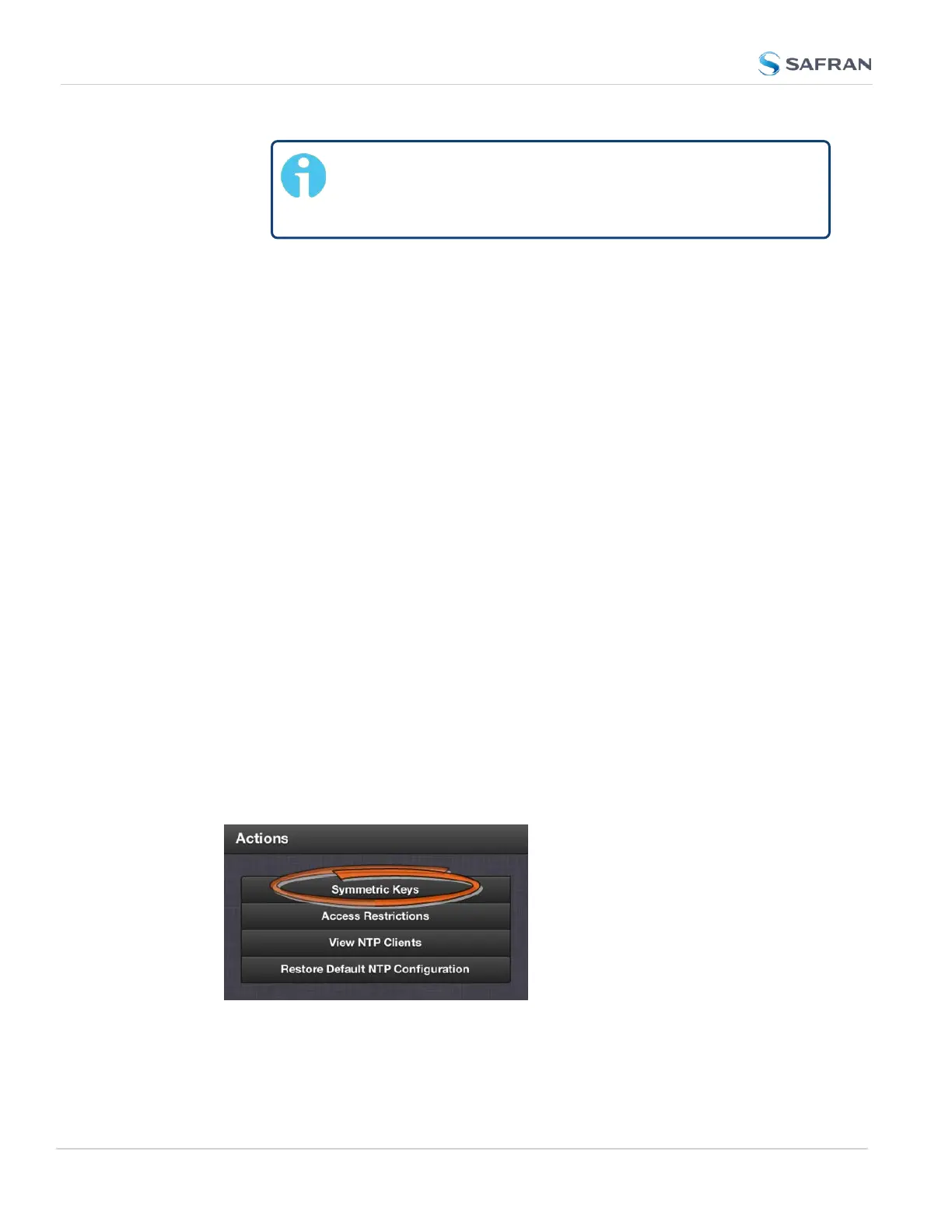
To create, edit, or delete Symmetric Keys (MD5 Authentication):
1.
Navigate to MANAGEMENT > NETWORK: NTP Setup.
2.
In the Actions panel, click the Symmetric Keys button:
3.
The NTP Symmetric Keys window will display:
130
CHAPTER 2 • SecureSync 2400 User Manual Rev. 5.2
2.15 Configure NTP


 To Next Page