Electrical equipment
Recharging
Bravo-Brava
55.
BATTERY
The batteries fitted on all versions of this ve-
hicle are the ES type (Energia Sigillata -
Sealed Energy) and are maintenance-free.
These type of battery have the following ad-
vantages compared with conventional ones:
- reduced electrolyte consumption due to
the use of a new type of alloy in the
con-
struction of,the.grilles and the,plates;
- reduced self-discharge which improves
starting for
a
period of 7 months and there-
fore these batteries lend themselves to pro-
longed storage (at temperatures below
28°C);
- a reduced volume of gases developed dur-
ing charging which are the ones which
cause corrosion and consequent poor
con-
tact at the terminal poles.
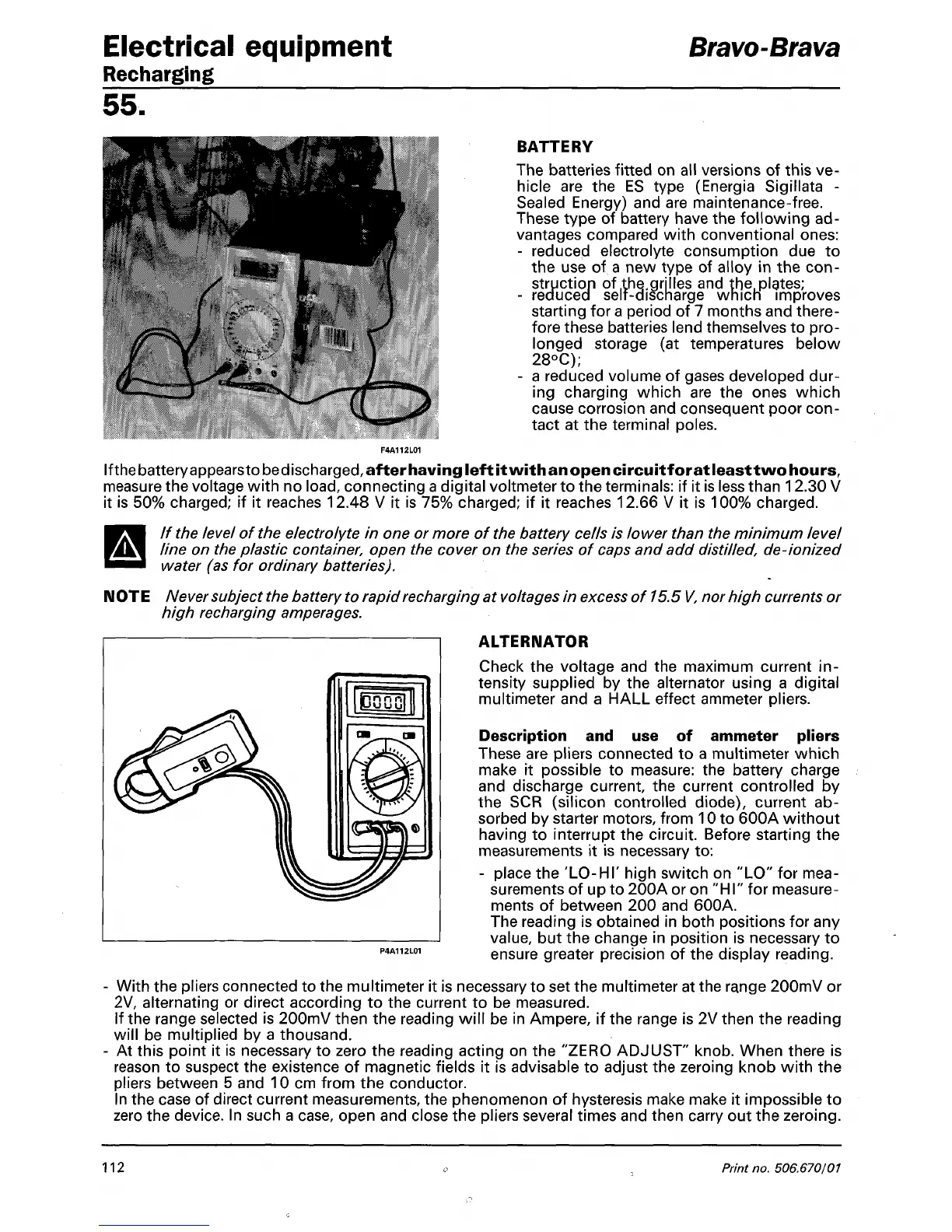
If thebatteryappearstobedischarged, after having left itwithanopencircuitforatleasttwo hours,
measure the voltage with no
load,
connecting a digital voltmeter to the terminals: if it is less than 12.30 V
it is 50% charged; if it reaches 12.48 V it is 75% charged; if it reaches 12.66 V it is 100% charged.
If the level of the electrolyte in one or more of the battery cells is lower than the minimum level
line on the plastic container, open the cover on the series of caps and add distilled, de-ionized
water (as for ordinary batteries).
NOTE Never subject the battery to rapid recharging at voltages in
excess
of 15.5
V,
nor high currents or
high recharging amperages.
ALTERNATOR
Check the voltage and the maximum current in-
tensity supplied by the alternator using a digital
multimeter and a HALL effect ammeter pliers.
Description and use of ammeter pliers
These are pliers connected to a multimeter which
make it possible to measure: the battery charge
and discharge current, the current controlled by
the SCR (silicon controlled diode), current ab-
sorbed by starter motors, from 10 to 600A without
having to interrupt the circuit. Before starting the
measurements it is necessary to:
- place the
'LO-HI'
high switch on "LO" for mea-
surements of up to 200A or on "HI" for measure-
ments of between 200 and 600A.
The reading is obtained in both positions for any
value,
but the change in position is necessary to
P4AH2L01
ensure greater precision of the display reading.
With the pliers connected to the multimeter it is necessary to set the multimeter at the range 200mV or
2V, alternating or direct according to the current to be measured.
If the range selected is 200mV then the reading will be in Ampere, if the range is 2V then the reading
will be multiplied by a thousand.
At this point it is necessary to zero the reading acting on the "ZERO ADJUST" knob. When there is
reason to suspect the existence of magnetic fields it is advisable to adjust the zeroing knob with the
pliers between 5 and 10 cm from the conductor.
In the case of direct current measurements, the phenomenon of hysteresis make make it impossible to
zero the device. In such a case, open and close the pliers several times and then carry out the zeroing.
112
° Print no. 506.670/07



 To Next Page