74Service Manual – CS7010™ 14 - Wheel System, Non-Traction
Troubleshooting
Problem Cause Correction
Thewheelsare
makingexcessnoise.
Thewheelbearingsworn. Checkthewheel,wheelbearings,andbrakeand
spindle assembly and replace as required.
Thewheeland/orbrakeand
spindle assembly are damaged.
Thebrakesarenot
workingcorrectly.
Thebrakesareoutofadjustment Adjustthebrakes.
Thebrakeliningsarewornout. Replacethebrakelinings.
Removal and Installation
Wheel
Wheel Bearing
Regardless whether the procedure is being completed to replace a wheel versus a bearing, both right and
left sides should be completed together. Replacing only 1 wheel can result in adverse brake wear if the brake
drums are not equal.
WARNING: Never work under a machine without safety stands or blocks to support the machine.
When jacking the machine, do so at the designated tie down/jacking locations.
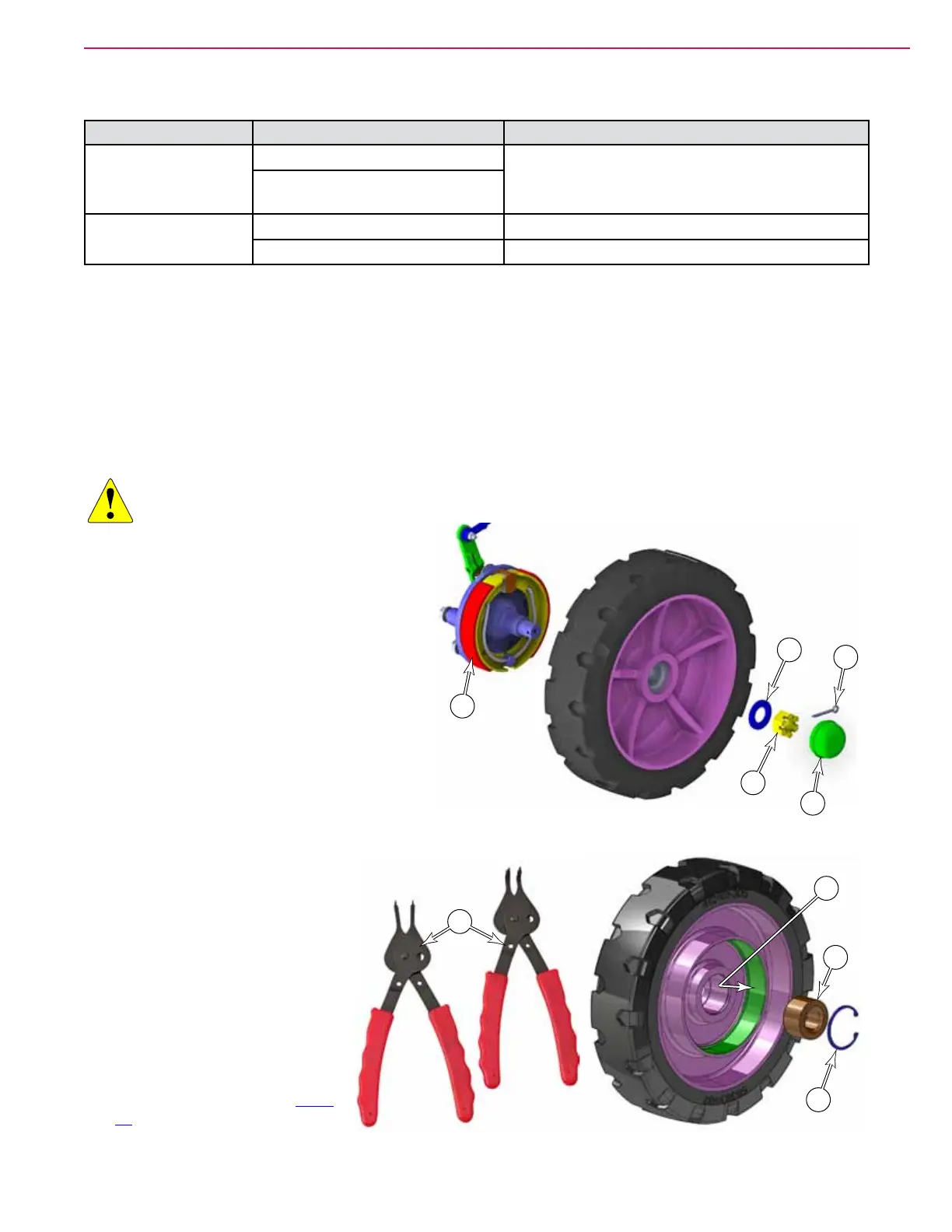
1. Jack the front of the machine enough
to raise the front wheels slightly off the
ground, and place jack stands under the
machine for safety.
2. Using a sharp-edged tool, carefully work
the dust cap (A) loose from the wheel. Take
care not to damage or deform the cap.
3. Remove the cotter pin (B) from the castle
nut (C), and remove the nut, washer (D),
and wheel from the axle spindle.
4. Using a retaining ring pliers (J), remove
the retaining ring (E) from the wheel hub,
and remove the bearing (F).
5. Before replacing the wheel,
inspect the brake linings (H)
and the drum surface (G) for
excessive wear.
6. During replacement, tighten
the castle nut (C) enough to be
slightly snug, and then continue
turning enough to insert the
cotter pin (B) through the shaft.
7. If the wheels have been
replaced, inspect the Brake
adjustment described on page
73
A
B
C
D
H
F
E
G
J


 To Next Page