Machinery Balancing Module
Two-Plane Balancing Procedure Overview
Two-Plane Balancing Procedure Overview
With 2 plane balancing, the measurement sequence proceeds in the same order as with
single-plane balancing, except two trial weights and two trial runs are required to
calculate four influence coefficients (only one influence coefficient exists for single-
plane).
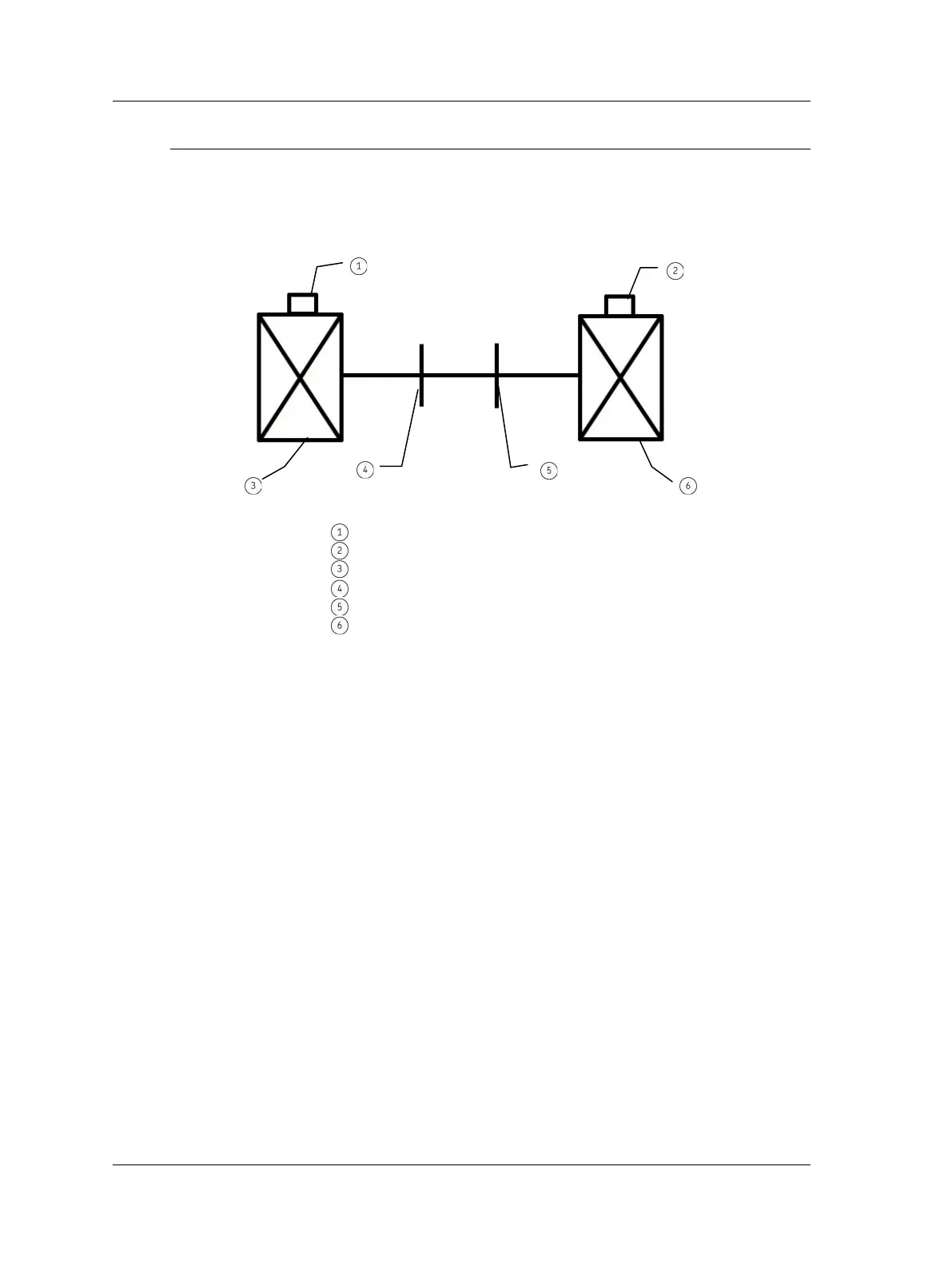
Figure 5 - 19.
Example of a 2 plane Balancing Setup.
1 - Set Up Balancing Equipment and Measurement Parameters
Stop - First, with the machine stopped, set up the balancing equipment and mark your
tachometer reference point on the rotor or shaft. Use Microlog Setup menu options to
configure balancing measurement parameters for the balancing run sequence.
2 - Perform the Reference Runs (Planes 1 and 2)
Spin - Start the machine and perform a reference run on each balancing plane. The
reference runs provide a “starting place” for balancing computations. They record the
machine's initial imbalance (1X vibration magnitude and phase angle) on each balancing
plane. Later in the procedure, reference run data is automatically compared with trial
(weight) run data to calibrate each planes unbalance.
3 - Attach Trial Weight to Plane 1
Stop - After collecting reference run data, stop the machine and add a trial weight to
plane 1. A trial weight is a temporary weight attached to produce a change from the
original unbalance readings (reference run readings). Input the trial weight amount and
placement angle into the Microlog.
5 - 24 SKF Microlog - GX Series
User Manual


 To Next Page
 Loading...