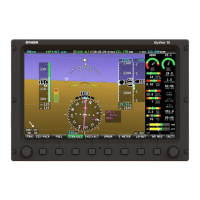
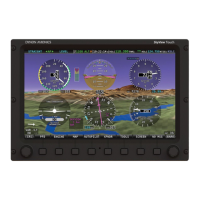
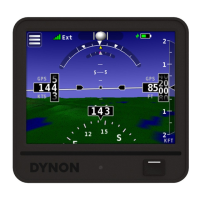
EFIS-D10A Standby Display Installation and Configuration
SkyView HDX System Installation Manual - Revision E 20-5
20.7.1 Attaching to Instrument Panel
When mount the EFIS-D10A directly into your panel, the front bezel of the unit will extend
beyond the plane of your panel by 0.8”.
Installation of the EFIS-D10A main unit should only be completed once all other physical
and electrical installations have been performed. This will ensure that last-minute
adjustments will not have to be made with the EFIS-D10A mounted in the panel.
The diagram above shows the dimensions expected for the proper installation of the
EFIS-D10A into your panel using no mounting bracket. All units are in inches. Push the
EFIS-D10A through the main panel
hole. The four studs on the back of the EFIS-D10A will fit into the four mounting holes
having dimensions listed in the diagram. Place one of the four supplied washers on each
stud before pushing the EFIS-D10A into place in the panel, putting the washers in
between the EFIS-D10A and the panel. Place one of the 4 supplied mounting nuts on the
end of each of the 4 studs protruding from the back of the panel. Secure the nuts tightly
against the panel to complete the installation.
20.7.2 Connecting Static and Pitot Lines to EFIS-D10A
The AOA, pitot, and static ports on the back of the EFIS-D10A are equipped with 1/8”
NPT Female fittings. To attach your pitot and static lines to the back of the EFIS-D10A,
you must use standard 1/8” NPT Male fittings at the end of each of the lines.
Connect your static and pitot sources to the EFIS- D10A, T’ing off of existing lines in the
aircraft. The pitot source must come from the existing aircraft pitot, not Dynon’s AoA
probe. View the following back view diagram the placement of your pressure lines. Use
two wrenches to both hold the brass fitting on the EFIS-D10A and secure the mating
pressure line fittings to the corresponding locations on the back of the EFIS-D10A.
Do not over-tighten or allow the brass fittings to rotate.
20.8 Post-Installation Configuration and Checkout Procedure
During manufacture, the EFIS-D10A underwent a comprehensive calibration, verification,
and burn-in routine that minimizes setup time and ensures that your EFIS meets Dynon’s
performance specifications. To account for individual airframes, there are a few simple
calibration and configuration steps that you must complete before using the EFIS-D10A.
The following steps must be completed in order as some steps rely on previous settings.
20.8.1 Initial Verification
Turn your unit on by energizing the aircraft power to which it is connected. Ensure that
the screen is bright and readable and that all instrument displays appear. If a desired
display item is not present, refer to the User’s Guide to use the CLUTTR feature to display
the missing item.
With the unit powered on, verify the following:
The airspeed indicates zero


 To Next Page