Quilting
Various Stitches
111
3
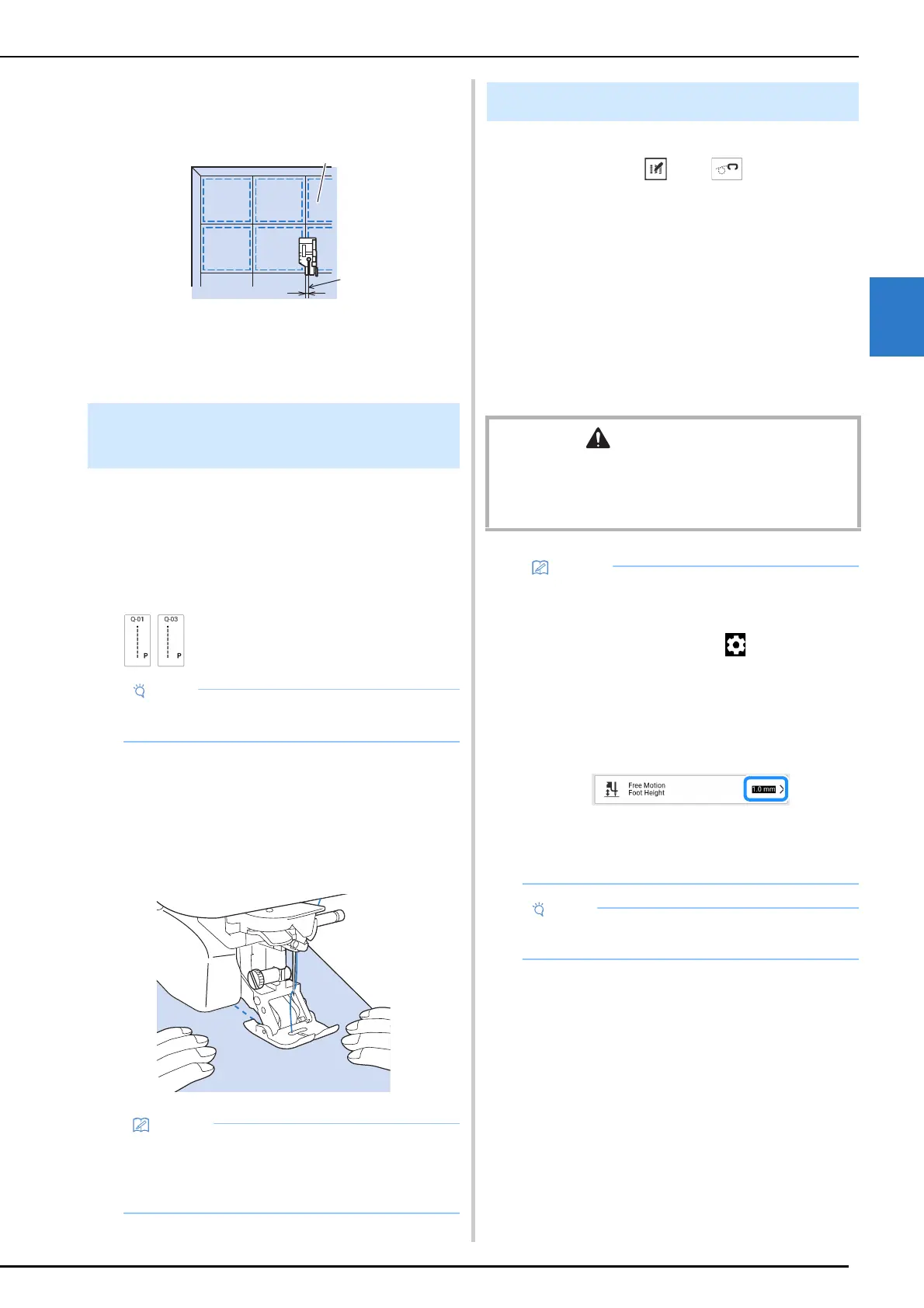
Topstitching quilting, 1/8 inch
Sew with the edge of the fabric or seam aligned
with the left side of the presser foot's front section.
a Right side of fabric
b Seam
c 1/8 inch
Sewing the quilt top, batting, and backing
together is called quilting. You can sew the quilt
with the compact dual feed foot to keep the quilt
top, batting, and backing from sliding.
1 Select a stitch.
2 Attach the compact dual feed foot.
(page 49)
3 Place one hand on each side of the
presser foot to hold the fabric secure
while sewing.
With free motion quilting, the feed dogs can be
lowered by touching then , so that the
fabric can be moved freely in any direction.
For free motion quilting, use free motion quilting
foot “C” or free motion open toe quilting foot “O”
depending on the stitch that is selected, and set
the machine to free motion sewing mode. In this
mode, the presser foot is raised to the necessary
height for free motion sewing.
We recommend attaching the foot controller and
sewing at a consistent speed. You can adjust the
sewing speed with the speed control slide on the
machine.
Quilting with the Compact Dual
Feed Foot
• If necessary, adjust the stitch length.
(page 61)
• Sew at slow to medium speed.
• Always check to be sure that your quilting
surface is securely basted before beginning to
sew.
Free Motion Quilting
CAUTION
• With free motion quilting, control the feeding speed of
the fabric to match the sewing speed. If the fabric is
moved faster than the sewing speed, the needle may
break and cause injury.
• When starting to sew, the internal sensor
detects the thickness of the fabric, and the
quilting foot is raised to the height specified in
the settings screen. Touch to display [Free
Motion Foot Height] of the settings screen.
Touch the number to select the height that the
quilting foot is raised above the fabric.
Increase the setting, for example, when
sewing very stretchy fabric, so that it is easier
to sew.
• In order to sew with a balanced tension, it may
be necessary to adjust the upper thread
tension. Test with a sample piece of fabric that
is similar to your chosen fabric.
• Do not be discouraged with your initial results.
The technique requires practice.



 To Next Page