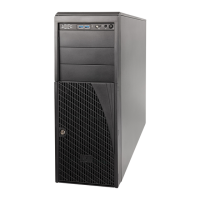
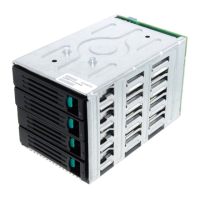
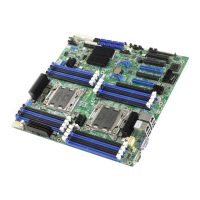
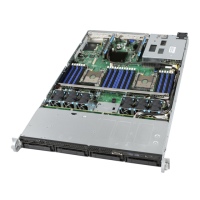
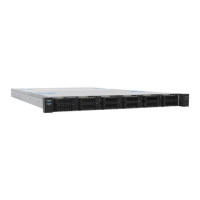
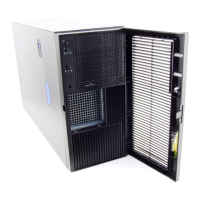
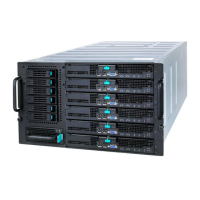
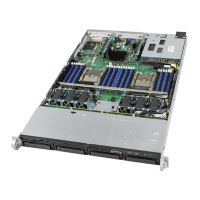
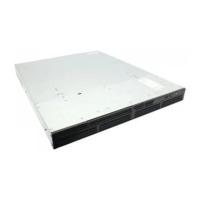
The Intel® Server D50DNP Family is a series of server products designed to support demanding high-performance computing (HPC) and artificial intelligence (AI) applications and workloads. The family includes building blocks for custom server system development, density-optimized Intel® D50DNP Module options, and fully integrated 2U rack-mount, multi-module systems. These servers support 4th Gen Intel® Xeon® Scalable family or Intel® Xeon® CPU Max Series processors.
Function Description:
The Intel® Server D50DNP Family provides a modular and scalable platform for data centers. It supports various module types—compute, management, Intel® Data Center GPU Max Series accelerator, and PCIe* accelerator modules—that can be configured within a chassis to meet specific workload requirements. The system is designed for both air-cooled and liquid-cooled configurations, offering flexibility in thermal management. The modular design simplifies system integration and service, allowing for the replacement of individual modules, system fans, power supplies, and Ethernet Management Port (EMP) modules without powering down the entire system.
Important Technical Specifications:
- Processor Support:
- Dual-socket E LGA4677.
- Supports 4th Gen Intel® Xeon® Scalable processors (Platinum 84xx, Gold 64xx, Gold 54xx series) and Intel® Xeon® CPU Max Series processors.
- Features three Intel® Ultra Path Interconnect (UPI) links at 16 GT/s.
- Maximum Processor Thermal Design Power (TDP) up to 350 W (server board only).
- Memory Support:
- Up to 16 DDR5 RDIMMs or 8 DDR5 RDIMMs plus 8 Intel® Optane™ Persistent Memory (PMem) 300 series modules (air-cooled configurations only).
- Registered DDR5 DIMM (standard RDIMM, 3DS-RDIMM, and 9x4 RDIMM) with ECC support.
- Memory data transfer rates up to 4800 MT/s.
- Up to 2 TB DDR5 memory capacity per processor (1 TB per processor).
- Up to 5 TB DDR5 and Intel® Optane PMem combined memory capacity per processor (2.5 TB per processor) for models supporting both.
- DDR5 standard voltage of 1.1 V.
- Liquid-cooled modules do not support Intel® Optane™ PMem 300 series modules.
- PCH Chipset:
- Intel® C741 chipset.
- Supports SATA III, USB 3.0, and PCIe 3.0.
- I/O Ports:
- One USB 3.0 port.
- One I/O breakout cable supporting two USB 3.0 port connectors (dual-stack), one VGA connector, and one serial port connector.
- Networking:
- One external 10GBASE-T Ethernet port (RJ45).
- One external 1000BASE-T Ethernet port (RJ45) dedicated to server management.
- Expansion Options (Riser Slots):
- 1U Compute Module: Two 1U single PCIe* slot riser card assemblies (iPC DNP1UMRISER or iPC DNP1URISER). Each supports one low-profile PCIe add-in card (x16 PCIe 5.0 electrical/mechanical) and a single 80/110-mm PCIe* or SATA M.2 SSD storage device. PCIe lanes are routed from CPU 0 and CPU 1.
- 2U Management Module: Two 2U dual PCIe* slot riser card assemblies (iPC DNP2UMRISER). Each supports two low-profile PCIe add-in cards (x16 PCIe 5.0 electrical/mechanical) and a single 80/110-mm PCIe* or SATA M.2 SSD storage device. PCIe lanes are routed from CPU 0 and CPU 1.
- PCIe Accelerator Module:* Two 2U full-length, dual PCIe slot riser card assemblies (iPC DNPACCLRISER1 and iPC DNPACCLRISER2). Each supports two full-height, full-length, double-width PCIe 5.0 (x16 mechanical, x16 electrical) slots for accelerator cards. PCIe lanes are routed from CPU 0 and CPU 1 through MCIO cables.
- Chassis Dimensions: 865 x 442 x 86.8 mm (L x W x H).
- Cooling:
- Liquid-cooled configurations: Liquid-cooling loop (per module), liquid-cooling plumbing connections on the back of the chassis, two 40 x 40 x 40 mm fans.
- Air-cooled configurations: Eight dual-rotor hot-swap system fans (four 60 x 60 x 56 mm fans and four 40 x 40 x 40 mm fans), one 40-mm fan per installed power supply unit (PSU).
- Power: Supports four 3000 W AC power supplies (liquid-cooled) or four 2700 W AC power supplies (air-cooled) with power redundancy (PSUs sold separately).
- Operating Temperature: 10–35°C ambient temperature.
Usage Features:
- System Integration: The guide provides detailed instructions for installing essential system components (processors, memory, power supply) for L6 integrated modules, which are not power-on ready out of the box. It also covers installation of system options and accessories for L9 integrated systems, which are power-on ready but may require additional features.
- Module Configuration: The system supports various module configurations, including up to four 1U half-width compute modules, up to two 1U full-width Intel® Data Center GPU Max Series accelerator modules, and combinations of 1U half-width modules with 2U half-width management modules.
- Rack Installation: The chassis can be installed into a rack using a fixed rail kit, which serves as a shelf. Mechanical lifts or two-person handling are recommended due to system weight.
- BIOS Setup Utility: The BIOS Setup Utility allows users to view and configure system settings, including boot options, security features, and memory settings. Keyboard commands are provided for navigation.
- System Software Updates: Intel recommends updating the full system software stack (CPLD, BIOS, BMC firmware, Intel® Management Engine firmware, and FRU data) to the latest available version for optimal performance and reliability.
- Diagnostic LEDs: The server board includes diagnostic LEDs on the front edge to display POST progress codes or halt error codes, aiding in troubleshooting system hang conditions.
Maintenance Features:
- Modular Design: The system's modular design facilitates easy replacement of field replaceable units (FRUs) such as modules, system fans, power supplies, and EMP modules.
- ESD Precautions: Strict electrostatic discharge (ESD) precautions are emphasized throughout the guide, including wearing anti-static wrist straps and using conductive workbench pads, to prevent damage to sensitive components.
- Air Duct Management: Air ducts are crucial for maintaining system thermals in air-cooled modules and must always be in place during operation. Procedures for their removal and installation are provided for component servicing.
- Processor Handling: Detailed instructions for assembling and installing processor heat sink modules (PHMs) are given, with warnings about delicate socket pins and sharp heat sink fins. Proper handling and torque specifications for fasteners are highlighted.
- Memory Module Handling: Specific procedures for installing memory modules (DDR5 DIMMs and Intel® Optane™ PMem 300 series modules) for both air-cooled and liquid-cooled configurations are outlined, including the use of thermal pads and DIMM latch tools.
- M.2 SSD Installation: Instructions for installing M.2 SSDs and their corresponding heat sinks or cold plates are provided, emphasizing the use of thermal interface material (TIM) for proper cooling.
- Liquid Cooling Loop: For liquid-cooled configurations, the guide details the installation and replacement of the liquid-cooling loop, including the application of thermal gap filler and securing cold plates.
- System Fan Replacement: System fans are hot-swappable and designed for redundancy. Instructions for their removal and installation are provided, with specific notes on fan types for air-cooled and liquid-cooled systems.
- Power Distribution Board (PDB) Replacement: This procedure requires powering off the entire system and disconnecting AC power cords due to the PDB's critical role.
- System Battery Replacement: Instructions for replacing the CR2032 lithium battery are included, along with warnings about proper disposal.
- Troubleshooting: The guide includes appendices with detailed POST code diagnostic LEDs, MRC progress codes, and POST error codes to assist service technicians in identifying and resolving system issues.
- Product Safety: Multi-language safety warnings are provided, covering power supply handling, AC power disconnection, ESD precautions, and environmental considerations for system operation.

 Need help?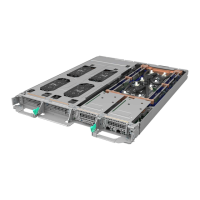

 To Next Page
 General