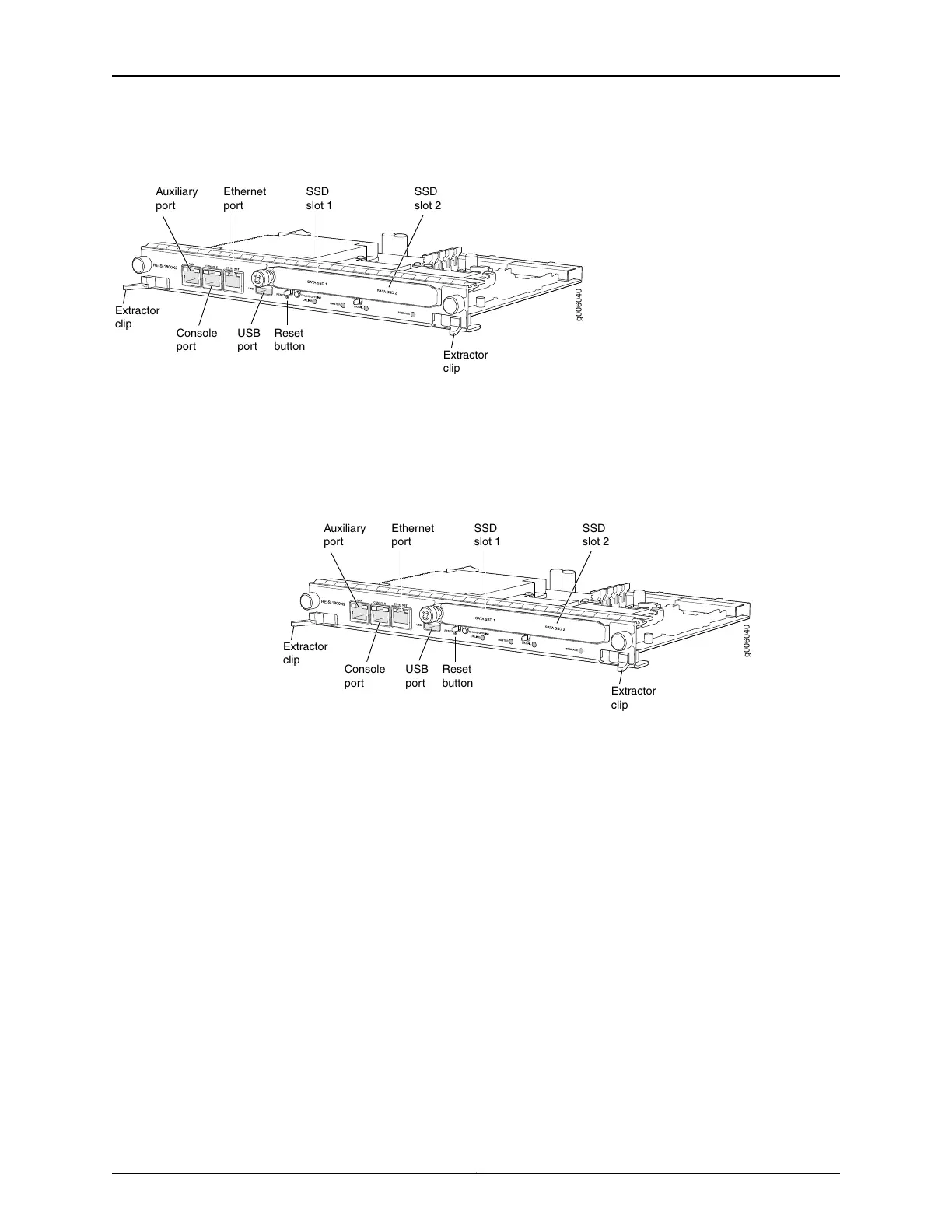
Figure 15: RE-S-1800 Front View
g006040
USB
port
Reset
button
Extractor
clip
Extractor
clip
Console
port
Auxiliary
port
Ethernet
port
SSD
slot 2
SSD
slot 1
•
RE-S-1800 Routing Engine Components on page 30
•
RE-S-1800 Routing Engine Boot Sequence on page 31
RE-S-1800 Routing Engine Components
Figure 16 on page 30 shows the RE-S-1800 Routing Engine.
g006040
USB
port
Reset
button
Extractor
clip
Extractor
clip
Console
port
Auxiliary
port
Ethernet
port
SSD
slot 2
SSD
slot 1
Each Routing Engine consists of the following components:
•
CPU—Runs Junos OS to maintain the router's routing tables and routing protocols..
•
DRAM—Provides storage for the routing and forwarding tables and for other Routing
Engine processes.
•
USB port—Provides a removable media interface through which you can install Junos
OS manually. Junos OS supports USB version 1.0.
•
CompactFlash card—Provides primary storage for software images, configuration files,
and microcode. The CompactFlash card is fixed and is inaccessible from outside the
router.
•
Solid-state Drive (SSD)—Provides secondary storage for log files, memory dumps,
and rebooting the system if the CompactFlash card fails.
•
Interface ports—The AUX, CONSOLE, and ETHERNET provide access to management
devices. Each Routing Engine has one 10/100/1000-Mbps Ethernet port forconnecting
to a management network, and two asynchronous serial ports—one for connecting to
a console and one for connecting to a modem or other auxiliary device.
•
EEPROM—Stores the serial number of the Routing Engine.
Copyright © 2017, Juniper Networks, Inc.30
MX480 3D Universal Edge Router Hardware Guide


 To Next Page