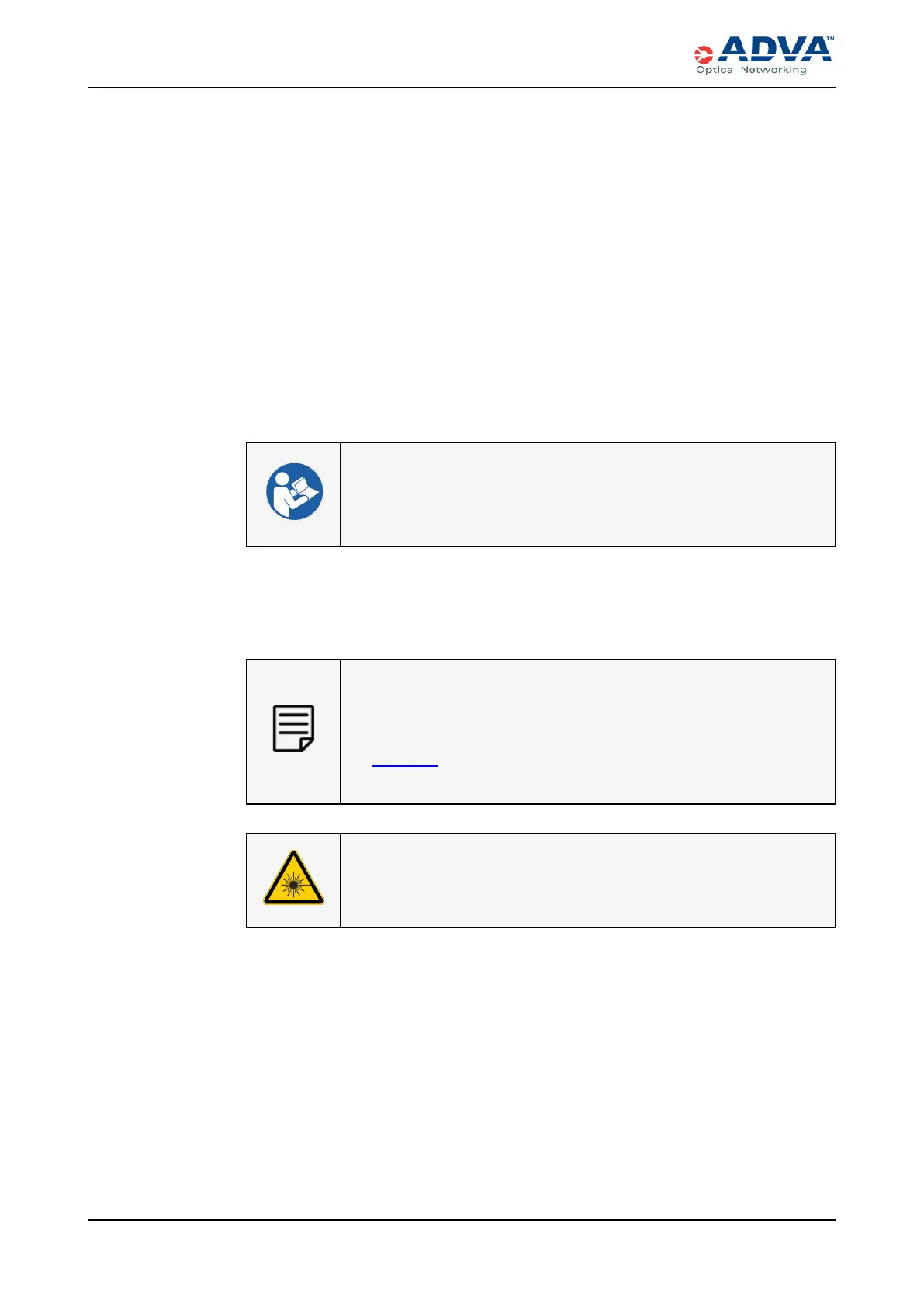
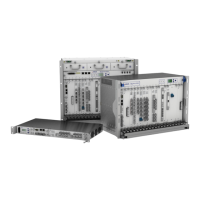
Installing a QSFPPluggable Transceiver
2. Verify that you are properly grounded with an anti-static wrist strap or heel strap
connected to the grounded ESDjack.
3. Hold the traffic module with the faceplate toward you and the levers extended.
4. Align the module edges with the guides of the shelf slot.
5. Lift out on the levers and gently apply pressure to the faceplate while pushing the
module into the appropriate slot.
6. Push on the faceplate to fully seat the module .
7. Press down on the locking levers to secure the module and connect it to the
backplane. The module is completely inserted when its faceplate is flush with the
faceplates of the adjacent modules and the shelf panels.
8. When the module is inserted completely, hand tighten the thumb screws to prevent
inadvertent dislodging. Do not overtighten.
9. Repeat this procedure for each traffic module needed for your configuration.
10. If necessary, repeat this procedure for each FSP 3000 C shelf.
l Electrostatic Discharge Damage Prevention and Warning
l Traffic Module Support
l Handling Modules
Installing a QSFPPluggable Transceiver
This procedure assumes that:
l The shelf is properly grounded to the rack;
l The shelf, module, and pluggable transceiver have been properly
inspected; and
l The module is installed in the shelf.
LASERRADIATIONWARNING
Each pluggable transceiver is a Class 1 laser product.
1. Use your installation plan to verify the following information about the pluggable
transceiver you are installing
o
What type of pluggable transceiver you are installing
o
Which traffic module will house this pluggable transceiver
o
Which module port will house this pluggable transceiver
2. Check the operating status of the equipment and the present hazard level. Please
keep in mind that the laser hazard level of the network element will be influenced
when any module is operating in "Forced On" mode. Do not proceed unless you are
familiar with the laser safety and you are protected accordingly.
222 FSP3000 C Hardware Guide - R1.1 - Issue:A (12/09/2016)


 To Next Page