1F–72 ENGINE CONTROLS
DAEWOO M-150 BL2
MAA1F110
DIAGNOSTIC TROUBLE CODE (DTC) – P0117 ENGINE COOLANT
TEMPERATURE SENSOR LOW VOLTAGE
Circuit Description
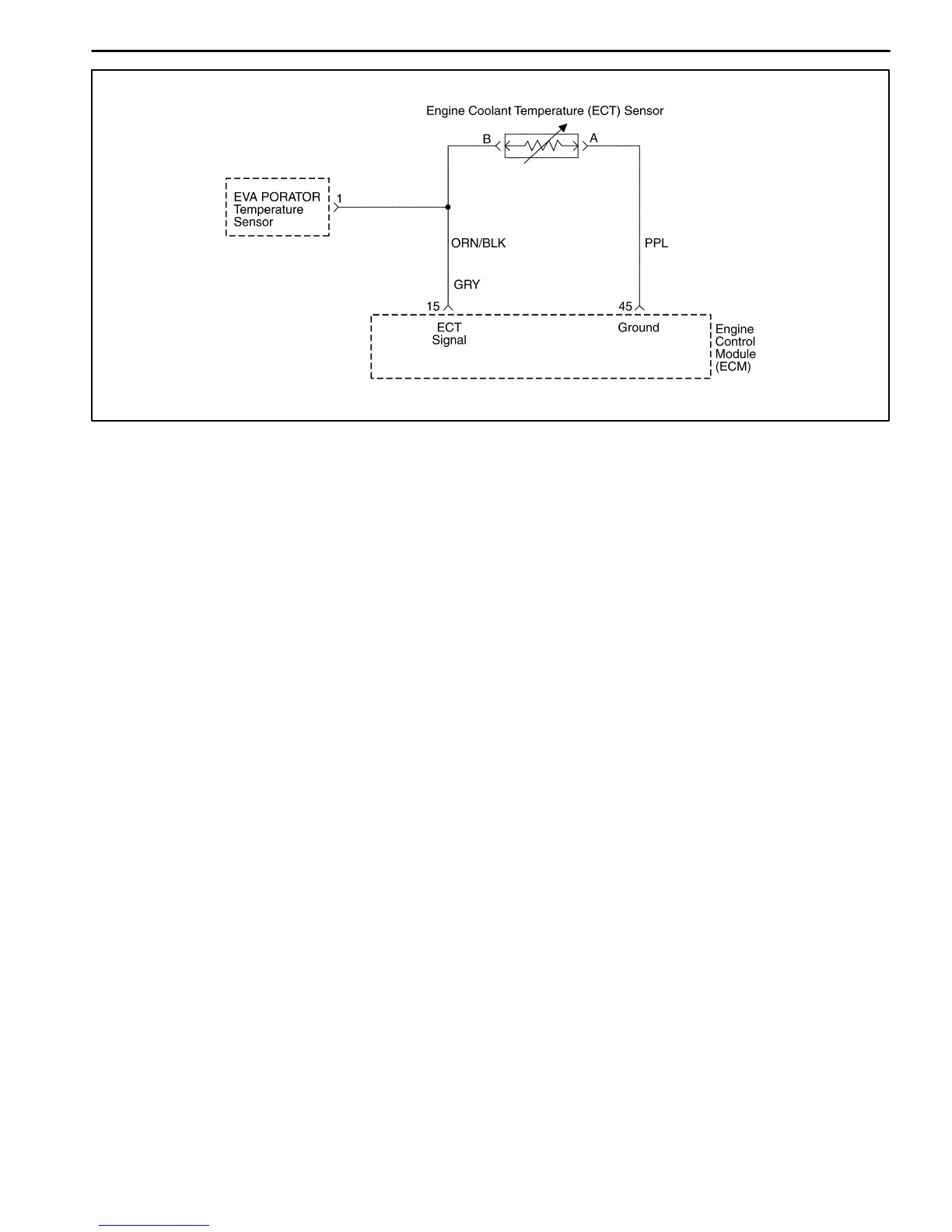
The Engine Coolant Temperature sensor (ECT) uses a
thermistor to control the signal voltage to the engine
control module (ECM).
The ECM supplies a voltage on the signal circuit to the
sensor. When the engine coolant is cold, the resistance
is high; therefore the ECT signal voltage will be high.
As the engine warms, the sensor resistance becomes
less, and the voltage drops. At normal engine operating
temperature, the voltage will be between 1.5 and 2.0
volts at the ECT signal terminal.
The ECT sensor is used to the following items:
D Fuel delivery.
D Lock Up Clutch (LUC).
D Ignition.
D Evaporator Emission (EVAP) Canister Purge Valve.
D Electric cooling fan.
Conditions for Setting the DTC
D This DTC can be stored in “key-on” status.
D The engine rum time is greater than 3 seconds.
D A low voltage condition exits.
D ECT voltage is less than 0.03V.
Action Taken when the DTC Sets
D The Malfunction Indicator Lamp (MIL) will illuminate.
D The ECM will record operating conditions at the time
the diagnostic fails. This information will be stored in
the Freeze Frame and Failure Records buffers.
D A history DTC is stored.
D The coolant fan turns ON.
D The ECM will default to 20°C(68°F)for the first 60
seconds of the engine run time, and then
92°C(198°F).
D the scan ttol will not show the defaulted value.
Conditions for Clearing the MIL/DTC
D The MIL will turn off after four consecutive ignition
cycles in which the diagnostic runs without a fault.
D A history DTC will clear after 40 consecutive warm-up
cycles without a fault.
D DTC(s) can be cleared by using the scan tool.
Diagnostic Aids
After the engine has started, the ECT should rise steadi-
ly to about 90°C(194°F) then stabilize when the thermo-
stat opens.
Use the temperature vs. resistance values table to eval-
uate the possibility of a skewed sensor. Refer to “Tem-
perature vs. Resistance” in this Section.


 To Next Page