CAPINTEC, INC. CAPTUS
®
4000e
2-8 FUNCTIONAL & TECHNICAL DESCRIPTION July 16
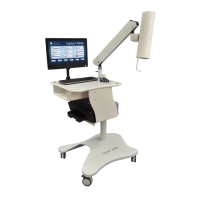
TUS Probe Detector
NaI(TI) flat face crystal / PM Tube .... 5.1 x 5.1 cm ... (2” x 2”)
Monoline construction
Resolution (Full Width-Half Max) – ≤9.5% or better for Cs137
Lead Shielded Collimator
Complies with ANSI Standard N44.3-1973
Coaxial Signal/High Voltage Cable ... 2.4 m ............. (8’) [maximum]
Well Detector – Optional
With attached (0.9 m (3’) maximum) Coaxial Signal/High Voltage Cable
NaI(TI) well type crystal / PM Tube ... 5.1 x 5.1 cm ... (2” x 2”)
Well diameter ........................ 1.6 cm ............ (0.625”)
Well depth ............................. 3.8 cm ............ (1.5”)
Monoline construction
Resolution (Full Width-Half Max) – ≤10.0% or better for Cs137
1” Lead Shielding
Lined with brass (0.16 cm (1/16”) thick) to minimize backscatter
Thickness ............................. 2.5 cm ............ (1”)
Height ................................... 32.5 cm .......... (12.8”)
Diameter ............................... 11.4 cm .......... (4.5”)
Weight .................................. 27.9 kg ........... (61.4 lb.)
2” Lead Shielding
Lined with brass (0.16 cm (1/16”) thick) to minimize backscatter
Thickness ............................. 5.1 cm ............ (2”)
Height ................................... 43.8 cm .......... (17.25”)
Diameter ............................... 16.8 cm .......... (6.625”)
Weight .................................. 93.0 kg ........... (205 lb.)
Environment Requirements
Operational
The instrument should be located where the level of the background radiation is as
low and as constant as possible.
The instrument should be located where the temperature is stable within a range of
+50°F to +85°F (+10°C to +30°C) and the maximum relative humidity is 90% non-
condensing for maximum reliability and accuracy.
The instrument should be located where the barometric pressure is within a range of
27–31 inches of mercury (91–105 kilopascals).


 To Next Page