If this command is disabled, the following strings are used as the node
identifier:
■
ERPSv1: 01-19-A7-00-00-01
■
ERPSv2: 01-19-A7-00-00-[Ring ID]
◆
Propagate TC
– Enables propagation of topology change messages from a
secondary ring to the primary ring. (Default: Disabled)
When a secondary ring detects a topology change, it can pass a message about
this event to the major ring. When the major ring receives this kind of message
from a secondary ring, it can clear the MAC addresses on its ring ports to help
the second ay ring restore its connections more quickly through protection
switching.
When the MAC addresses are cleared, data traffic may flood onto the major
ring. The data traffic will become stable after the MAC addresses are learned
again. The major ring will not be broken, but the bandwidth of data traffic on
the major ring may suffer for a short period of time due to this flooding
behavior.
◆
Non-ERPS Device Protection – Sends non-standard health-check packets
when an owner node enters protection state without any link down event
having been detected through Signal Fault messages. (Default: Disabled)
■
The RPL owner node detects a failed link when it receives R-APS (SF - signal
fault) messages from nodes adjacent to the failed link. The owner then
enters protection state by unblocking the RPL. However, using this
standard recovery procedure may cause a non-EPRS device to become
isolated when the ERPS device adjacent to it detects a continuity check
message (CCM) loss event and blocks the link between the non-ERPS
device and ERPS device.
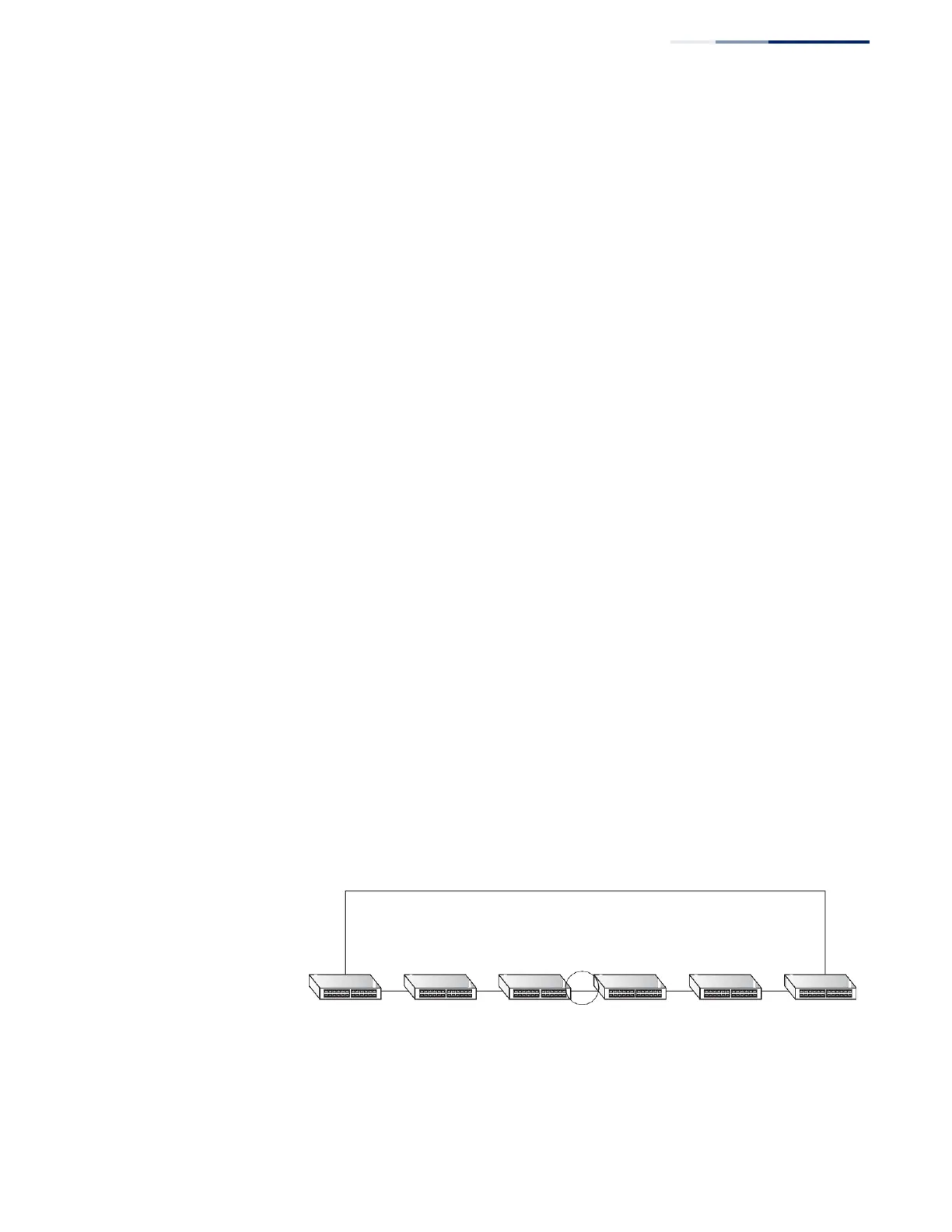
CCMs are propagated by the Connectivity Fault Management (CFM)
protocol. If the standard recovery procedure were used as shown in the
following figure, and node E detected CCM loss, it would send an R-APS (SF)
message to the RPL owner and block the link to node D, isolating that non-
ERPS device.
Figure 272: Non-ERPS Device Protection
RPL
A B
blocked
X
C D
fault
blocked
X
RPL
E F
Owner
non-ERPS non-ERPS
When non-ERPS device protection is enabled on the ring, the ring ports on
the RPL owner node and non-owner nodes will not be blocked when signal
loss is detected by CCM loss events.




 To Next Page