Matrix ETERNITY NE System Manual 937
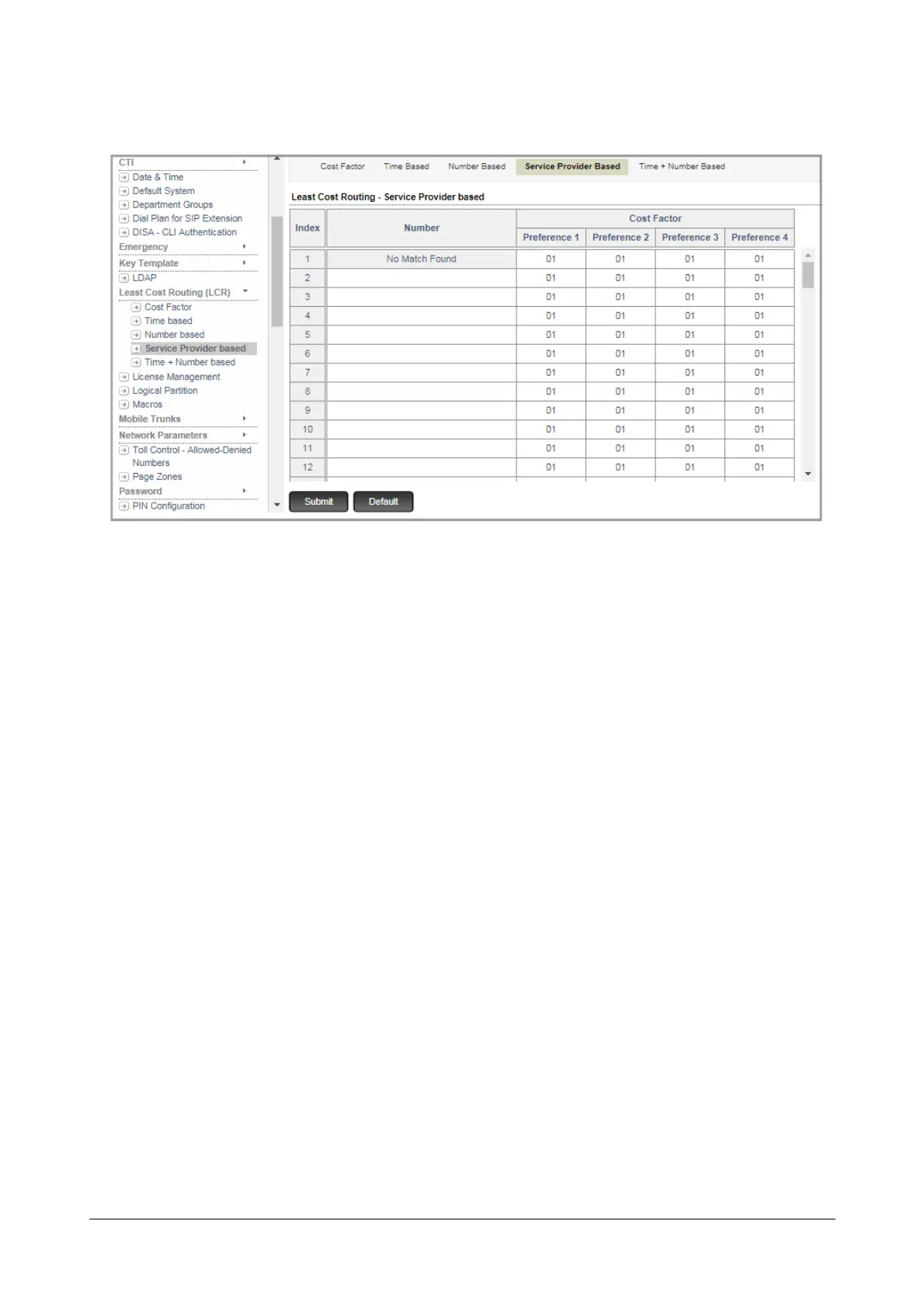
• Click Service Provider Based.
• Enter the values of the Service Provide based LCR you prepared on the sheet of paper in the appropriate
fields.
• In Number, you can enter a complete telephone number, a truncated phone number or an area code. You
may enter upto 64 characters (Digits + “Wildcard Characters”) in this field. Valid characters: 0 to 9, *, #, X,
T, Comma [,], Hyphen [-], Caret [^ ]. Default: Blank.
• Click Submit.
Configuring Time and Number based LCR
• This is a combination of the Time Zone based and Number based LCR. You may use this feature if your
service providers offer lower call rates for calls made to certain numbers during a certain time of the day.
• On a sheet of paper, make a table for Time and Number based LCR.
• Define the Time Zones when the service providers offer lower tariff. You can define up to 8 time zones.
• For each Time Zone you define, specify the Number strings on which lower tariff is applied during that
Time Zone. The number can be a maximum of 64 characters (Digits + Wildcard characters). Valid
characters: 0 to 9, *, #, X, T, Comma [,], Hyphen [-], Caret [^ ]. See “Wildcard Characters” to know the
various number patterns you can use.
• For each Number string you enter for a particular time zone, assign Cost Factor. Select a trunk as your first
preference. Select trunks of your second, third and fourth preferences. Refer to the table you prepared for
assigning Cost Factor.
• You can enter up to 99 different number strings, which are stored at Index numbers from 01 to 99. The
Number strings may be complete telephone numbers, truncated phone numbers or area codes.
When the trunk you selected as first preference is busy, the system will route the call through the next
trunk you set as preference if it is free.


 To Next Page