7.5
Date Code 20171006 Instruction Manual SEL-400 Series Relays
Metering
Maximum/Minimum Metering
Maximum/Minimum Metering
The relay measures and retains the deviations of the power system since the last
maximum/minimum reset. Knowing these maximum and minimum quantities
can help you operate your power system more effectively in a variety of ways.
For example, you can benefit from maximum/minimum metering information by
using it to track power flow for troubleshooting, planning future expansion, and
scheduling maintenance.
NOTE: Not all SEL-400 series relays
support maximum/minimum
metering.
The relay provides maximum/minimum metering for a variety of line and breaker
quantities, as well as for dc battery voltage. The relay also records the maximum
values of the sequence voltages and sequence currents.
View or Reset Maximum/Minimum Metering Information
The relay shows time stamped maximum/minimum quantities when you use a
communications port or
ACSELERATOR QuickSet SEL-5030 Software to view
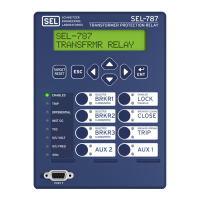
these quantities. In addition, you can read the maximum/minimum quantities on
the relay front-panel LCD screen.
To reset the maximum/minimum values, use the MET RM command from a
communications terminal, or use the RESET button in the QuickSet HMI > Meter
and Control > Maximum/Minimum window, or answer
Y and press ENT at the
Maximum/Minimum submenu reset prompt on the front-panel LCD screen. You can
also reset maximum/minimum metering with Global settings (typically RST-
MML, RSTMMB1, and RSTMMB2).
Maximum/Minimum Metering Updating and Storage
The relay updates maximum/minimum values once per power system cycle. The
relay stores maximum/minimum values and the corresponding dates and times to
nonvolatile storage once per day. If greater than a previously stored maximum or
less than a previously stored minimum, the new value overwrites the previous
value. Should the relay lose control power, it will restore the maximum/minimum
information saved at 23:50 hours on the previous day.
The relay updates maximum/minimum values under the following conditions:
➤ DFAULT is deasserted (equals logical 0)
➤ The metering value is greater than the previous maximum, or less
than the previous minimum, for 2 cycles
➤ Voltage input is greater than 13 V secondary
➤ Current input is greater than 0.05 • I
NOM
(in secondary amperes)
Megawatt and megavar maximum/minimum values are subject to the above volt-
age thresholds, current thresholds, and conditions.
When you use Equation 7.1, you add an error amount related to the nominal
current rating of the relay, I
NOM.
Use just the numeric portion of I
NOM
,
either “5” for a 5 A relay or “1” for a 1 A relay; do not use the unit (A). The
errors in Equation 7.1 are very small and qualify the relay as a high-accuracy
meter.
Example 7.1 Calculating Exact Error Coefficients (Continued)


 To Next Page