5.59
Date Code 20171021 Instruction Manual SEL-421 Relay
Protection Functions
Out-of-Step Logic (Zero Settings)
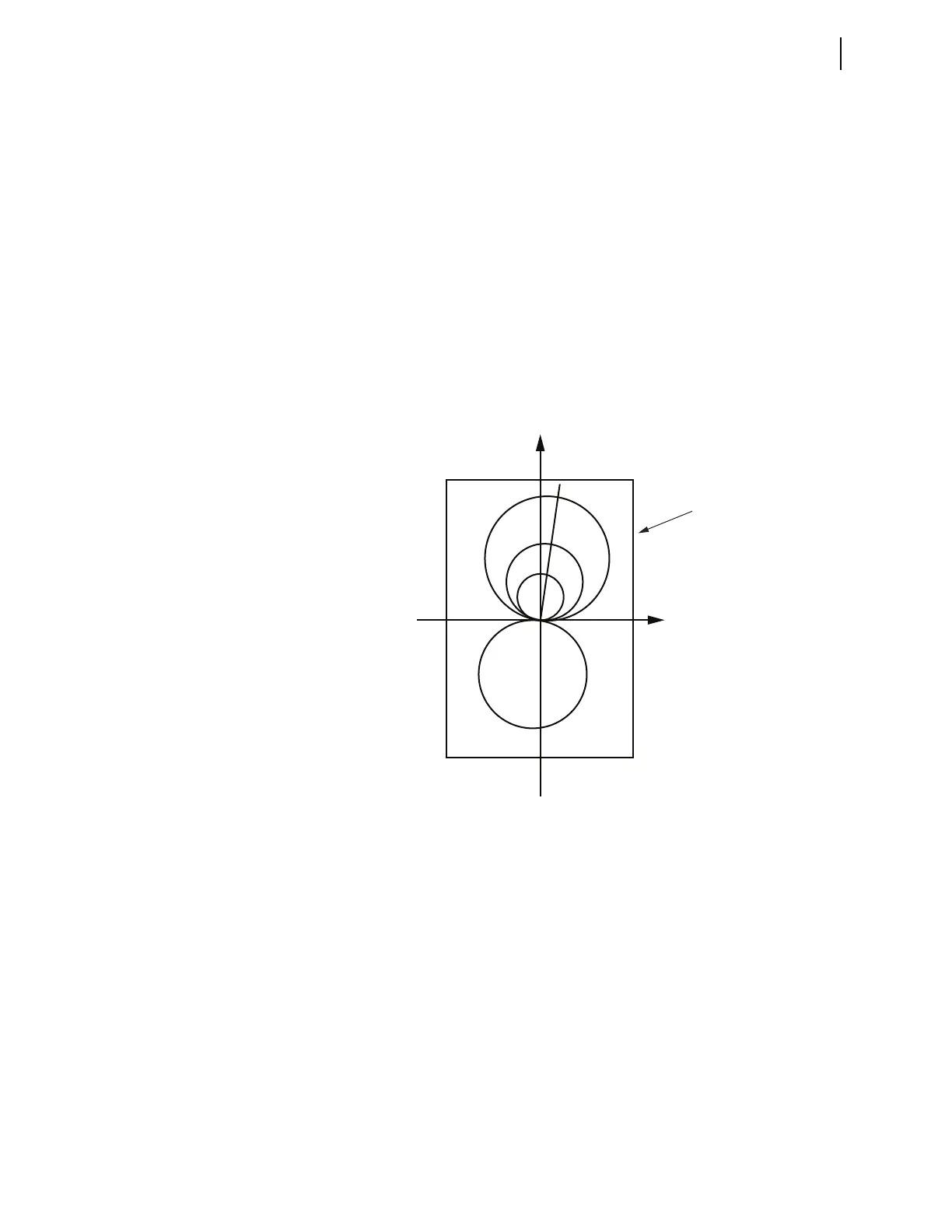
The purpose of the starter zone is to reduce the sensitivity of the power-swing
detector by allowing the PSB elements to assert only for those trajectories of the
positive-sequence impedance (Z1) that could possibly move into the characteris-
tic of any distance element during a power swing. The area of the starter zone is a
rectangle that encompasses all the distance characteristics that must be blocked
during a power swing, as shown in Figure 5.39. Furthermore, if the out-of-step
tripping (OST) is enabled, the starter zone also encompasses the largest relay
characteristic set for the OST logic (Zone 7; see Out-of-Step Tripping (OST)—
Zero Settings Element on page 5.68). The algorithm automatically calculates the
Starter Zone from the Z2MP–Z5MP, XP2–XP5, and RP2–RP5 Group settings,
using the following equations:
R_SZ = max (2 • Z2P, OOSB2, 1.5 • Z3P, OOSB3, 1.5 • Z4P, OOSB4, 1.5 •
Z5P, OOSB5)
X_SZ = max (3 • Z2P, OOSB2, 2 • Z3P, OOSB3, 2 • Z4P, OOSB4, 2 • Z5P,
OOSB5)
The slope detector typically detects the majority of power-swing conditions.
However, there are some system conditions for which the slope detector may not
operate. To ensure correct relay power-swing operation, the OSB function also
includes two additional detectors: a swing signature detector and a dependable
PSB detector.
The Swing Signature Detector
The swing signature detector (SSD) complements the slope detector and supple-
ments the dependable PSB logic. To distinguish a power swing from a system
fault, the swing signature detector uses the combination of a step change in the
system voltage and the assertion of distance-element-based protection elements
(see Figure 5.40).
Figure 5.39 Starter Zone Characteristic
Starter Zone
j X
R


 To Next Page