6.31
Date Code 20171021 Instruction Manual SEL-421 Relay
Protection Applications Examples
500 kV Parallel Transmission Lines With Mutual Coupling Example
Calculate T
0
and T
2
for a ground fault at the remote bus (i.e., m equals one per
unit). The magnitude of whichever angle is greater indicates that the correspond-
ing network is less homogeneous for a ground fault at the remote bus. The remote
bus is selected for the fault location to prevent Zone 1 ground-distance overreach.
Table 6.15 provides the results of Equation 6.14 and Equation 6.15 for both the
negative-sequence and zero-sequence networks. The negative-sequence network
is more homogeneous than the zero-sequence network because the magnitude of
T
2
is less than the magnitude of T
0
.
Select negative-sequence current flowing in the line as the polarizing quantity for
the ground-distance quadrilateral reactance measurement.
XGPOL := I2. Quadrilateral Ground Polarizing Quantity (I2, IG)
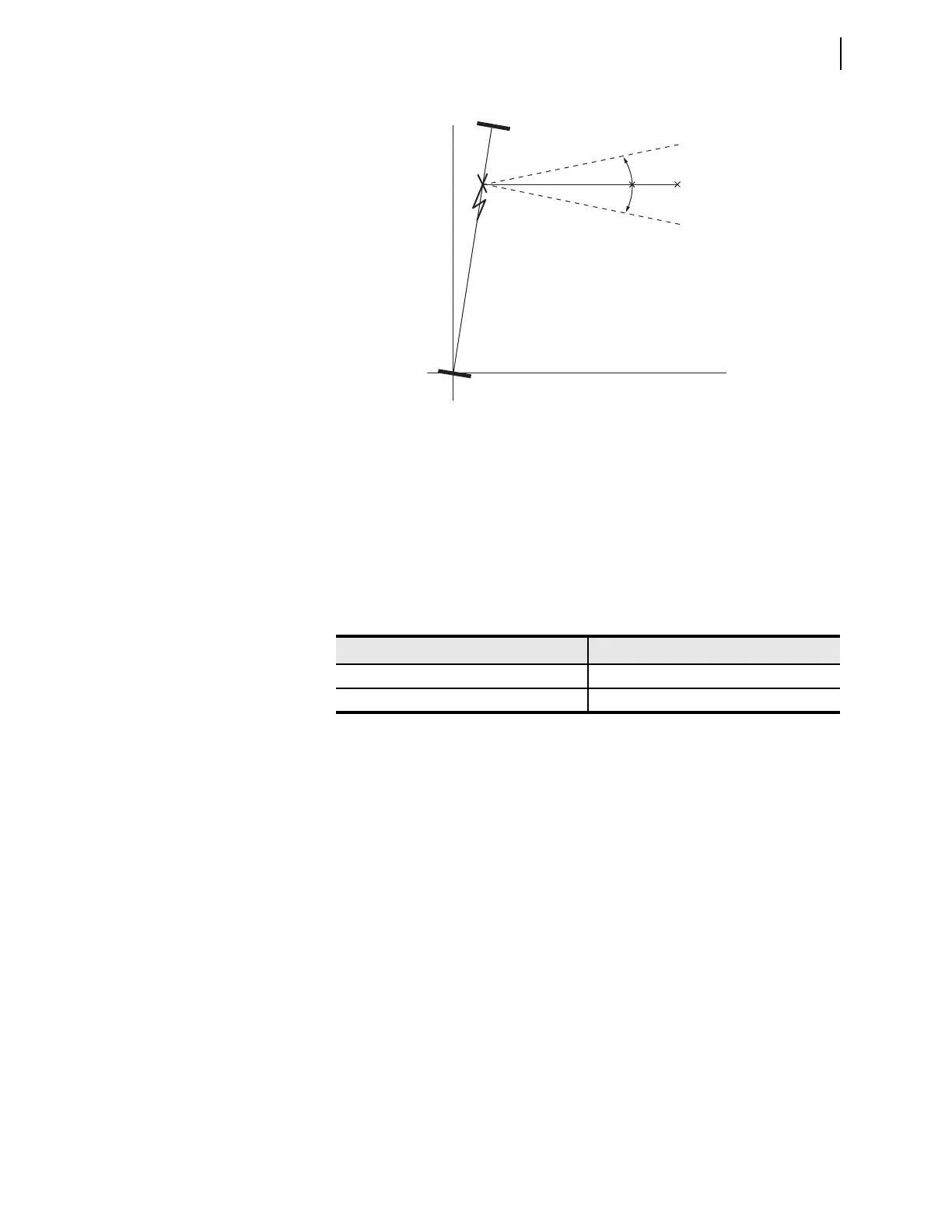
Nonhomogeneous Correction Angle
TANGG is the nonhomogeneous angle setting that also helps prevent overreach
or underreach by compensating the angle of the reactance line.
Figure 6.7 Tilt in Apparent Fault Impedance Resulting From Nonhomogeneity
Table 6.10 Tilt Resulting From Nonhomogeneity
Calculation Angle
T
2
–0.2°
T
0
–4.1°


 To Next Page