5.15
Date Code 20171021 Instruction Manual SEL-421 Relay
Protection Functions
Frequency Estimation
essary. This setting provides less expansion of the distance element
characteristics, while still providing security for zero-voltage three-phase faults.
SEL recommends that you use this setting.
If your application requires more expansion of the distance element characteris-
tics, set VMEMC = 1. When VMEMC is asserted, the relay normally uses
medium length memory and automatically switches to the long memory when
necessary. This setting provides the same element operation as provided in firm-
ware R312 and earlier, including greater expansion of the distance element char-
acteristics and the same security for zero-voltage three-phase faults.
The short memory is not available for series-compensated lines
(ESERCMP = Y). When ESERCMP = Y, the relay uses the medium length mem-
ory and automatically switches to the long memory polarizing quantity when the
relay detects voltage inversion or positive-sequence voltage magnitude lower
than a threshold.
Frequency Estimation
The relay uses filtered analog values related to the system frequency to calculate
internal quantities such as phasor magnitudes and phase angles. When the system
frequency changes, the relay measures these frequency changes and adapts the
processing rate of the protection functions accordingly. Adapting the processing
rate is called frequency tracking.
Note that frequency measurement is not the same as frequency tracking. The
relay first measures the frequency and then tracks the frequency by changing the
processing rate.
The relay measures the frequency over the 20–80 Hz range (protection frequency,
see FREQP in Table 5.16), but only tracks the frequency over the 40–65 Hz range
(see FREQ in Table 5.16). If the system frequency is outside the 40–65 Hz range,
the relay does not track the frequency. Instead, it clamps the frequency to either
limit. For frequencies below 40 Hz, the relay clamps the frequency at 40 Hz. For
frequencies above 65 Hz, the relay clamps the frequency at 65 Hz.
To measure the frequency, the relay calculates the alpha component quantity and
then estimates the frequency based on the zero-crossings of the alpha component.
Relay Word bit FREQOK asserts when the relay measures the frequency over the
range 20–80 Hz. If the frequency is below 40 Hz or above 65 Hz, FREQ reports
the clamped values of either 40 Hz or 65 Hz. In this case, the relay no longer
tracks the frequency. Instead, it uses either 40 Hz or 65 Hz to calculate the inter-
nal quantities.
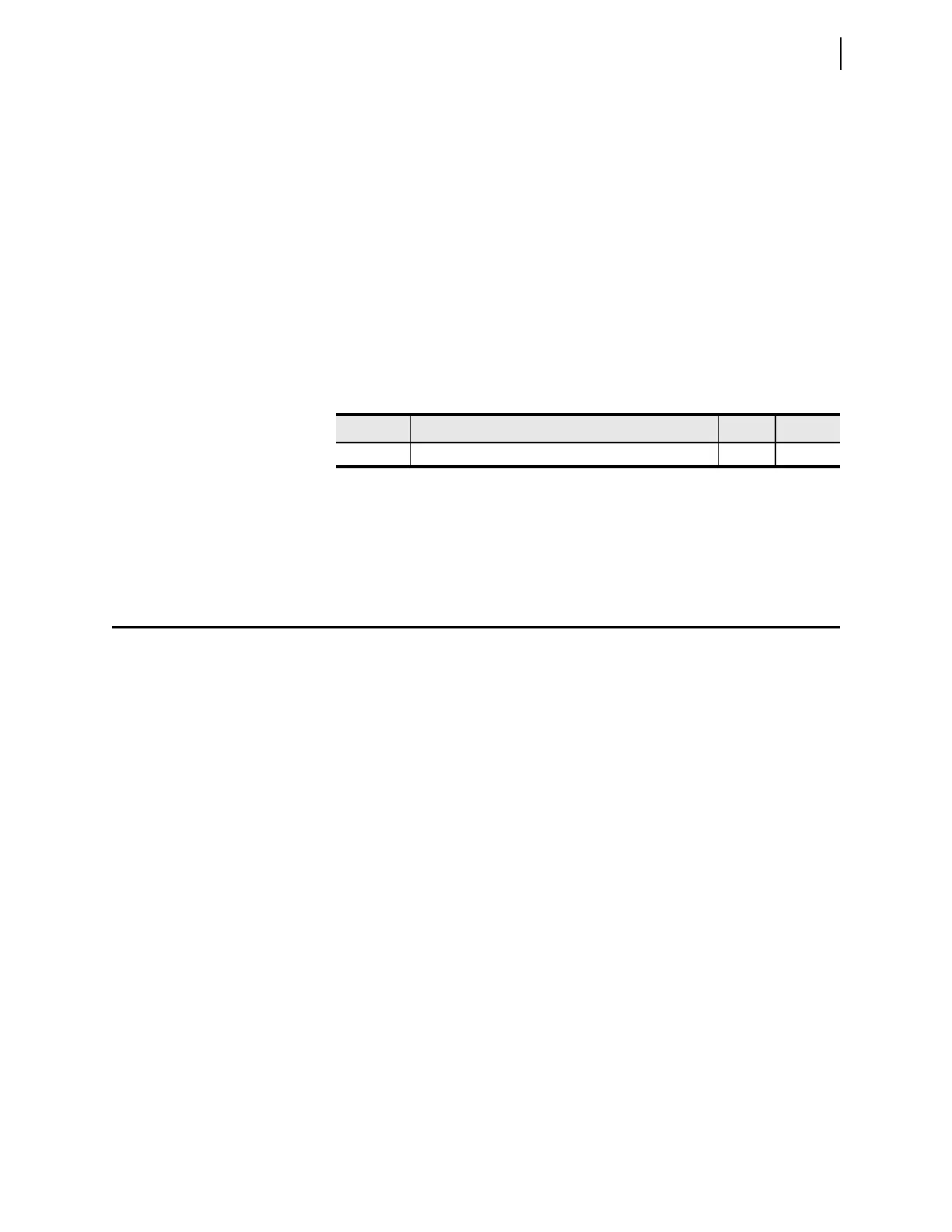
Table 5.12 VMEMC Relay Setting
Setting Prompt Range Default
VMEMC
a
a
If the Advanced Settings are not enabled (setting EADVS :=N), the relay hides the setting. If the
Series Compensation Line Logic Setting is enabled (setting ESERCMP := Y), the relay hides the
setting.
Memory Voltage Control (SELOGIC Equation) SV 0
b
b
Setting VMEMC is forced to 1 if the Series Compensation Line Logic Setting is enabled (setting
ESERCMP := Y).


 To Next Page