7.14
SEL-421 Relay Instruction Manual Date Code 20171021
Metering, Monitoring, and Reporting
Reporting
➤ Active group at trigger time
➤ Targets
➤ Circuit breaker trip and close times; and auxiliary contact(s) status
➤ Prefault and fault voltages, currents, and sequence current (from the
event report row with the largest current)
➤ MIRRORED BITS communications channel status (if enabled)
The relay derives the summary target information and circuit breaker trip and
close times from the rising edge of relevant Relay Word bits during the event. If
no trip or circuit breaker element asserted during the event, the relay uses the last
row of the event.
Fault location data can be indeterminate (for example, when there is no fault on
the power system). If this is the case, the relay displays “$$$$.$$” for the Loca-
tion entry in the event summary. You will also see the “$$$$.$$” display if the
fault location enable setting EFLOC is N.
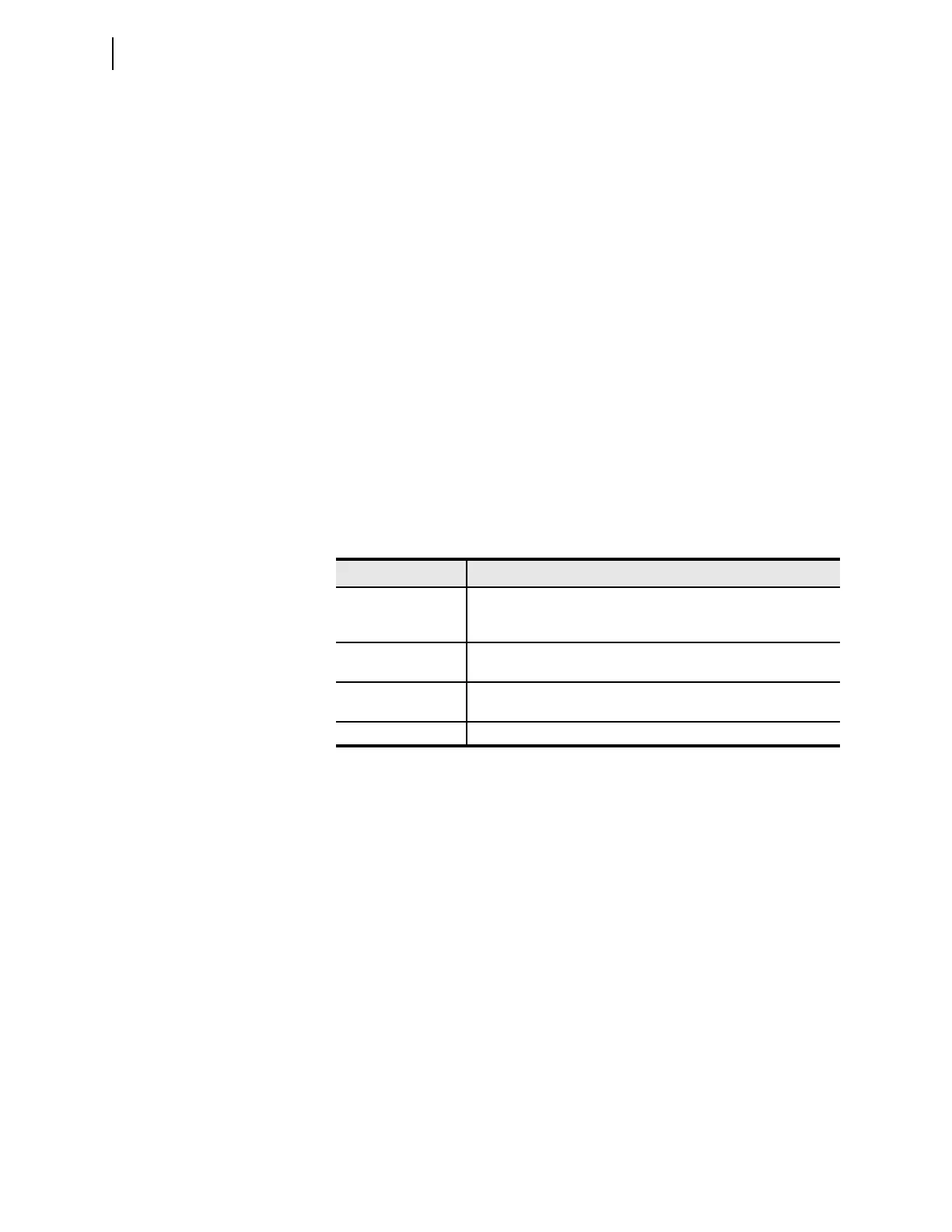
The SEL-421 reports the event type according to the output of the fault location
algorithm. Tab le 7.10 lists event types in fault reporting priority. Fault event types
(AG, BG, and BCG, for example) have reporting priority over indeterminate fault
events. For example, you can trigger an event when there is no fault condition on
the power system by using the TRI command. In this case, when there is no fault,
the relay reports the event type as TRIG.
Event History
The event history gives you a quick look at recent relay activity. The relay labels
each new event with a unique number from 10000 to 42767. (At 42767, the top of
the numbering range, the relay returns to 10000 for the next event number and
then continues to increment.) See Figure 7.7 for a sample event history.
The event history contains the following:
➤ Standard report header
➢ Relay and terminal identification
➢ Date and time of report
➤ Event number
➤ Event date and time
➤ Event type
➤ Location of fault (if applicable)
➤ Maximum phase current from summary fault data
Table 7.10 Event Types
Event Event Trigger
AG, BG, CG, ABC,
AB, BC, CA, ABG,
BCG, CAG
The relay reports phase involvement. If Relay Word bit TRIP asserts
at any time during the event, the relay appends a T to the phase
(AG T, for example).
TRIP The event report includes the rising edge of Relay Word bit TRIP, but
phase involvement is indeterminate.
ER The relay generates the event with elements in the SEL
OGIC control
equation ER, but phase involvement is indeterminate.
TRIG The relay generates the event in response to the TRI command.


 To Next Page