● The constant is primarily used to specify data sizes and quantities such as the setting values
for the timer.
● In the PLC, the decimal constant (U) is processed as binary (BIN) data in units of 16 bits, as
shown below.
● For unsigned decimal (U), all 16 bits are used to represent a numerical value, so it is not
possible to represent a negative value.
● Data is normally handled in units of one word (16 bits), however, it is also occasionally
handled in units of two words (32 bits).
■
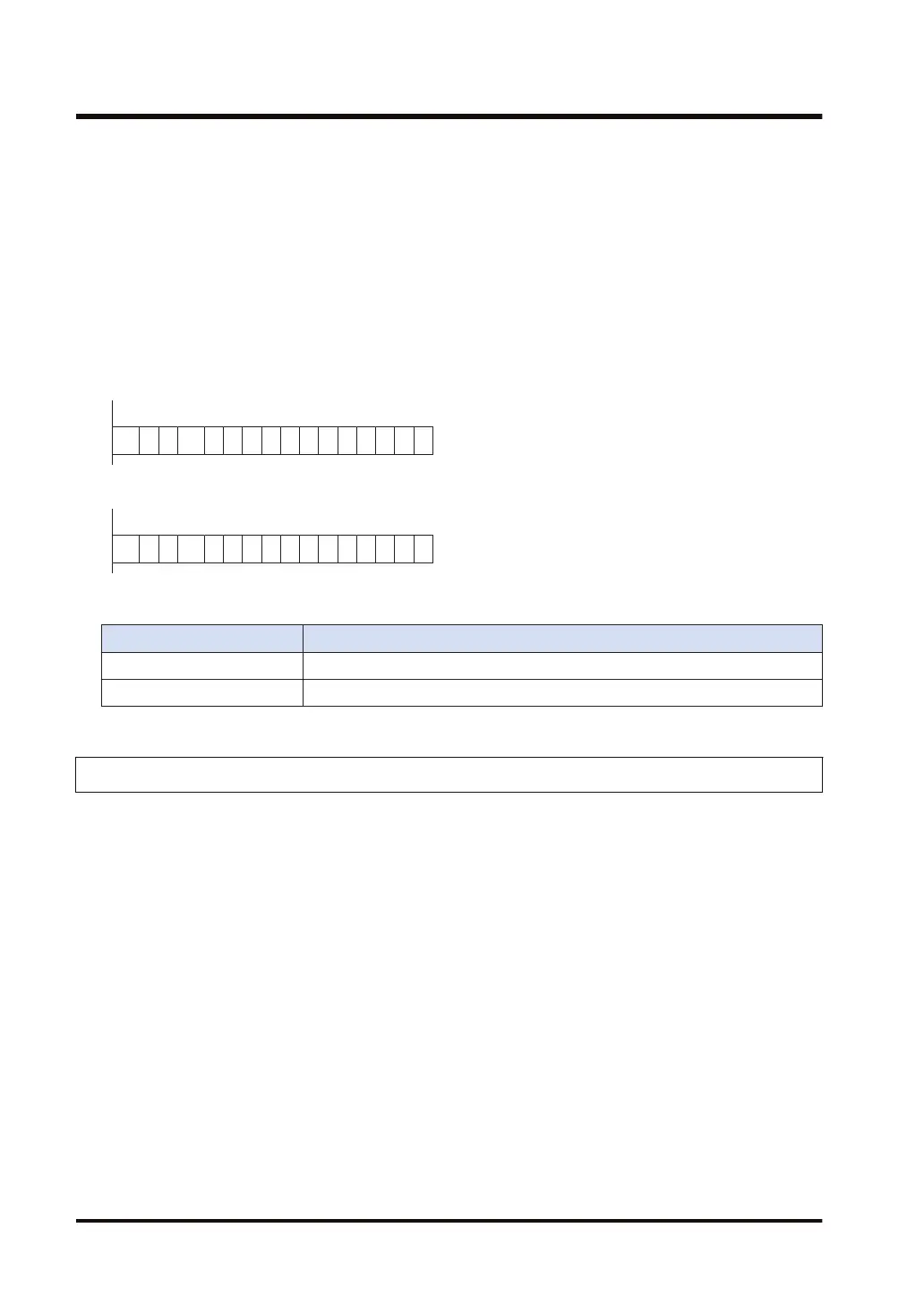
Format for unsigned decimal constant (U)
<Example> Decimal "+32" (U32)
15 12 9 5 0
0 0 0 0 0 0 0 0 0 0 1 0 0 0 0 0
<Example> Decimal "+65504" (U65504)
15 12 9 5 0
1 1 1 1 1 1 1 1 1 1 1 0 0 0 0 0
■
Range that can be specified using a decimal constant (U)
Operation Available range
16-bit operation U0 to U65,535
32-bit operation U0 to U4,294,967,295
2.7.3 H Hexadecimal constant
■
How hexadecimal constant (H) works
● The constant is a value which has been converted from binary data into hexadecimal data.
When entering and reading the constant, specify "H" before the numerical value.
● Hexadecimal constants are primarily used to specify an ordering of 1's and 0's in 16-bit data,
such as system data register settings and specification of control data for high-level
instructions. Hexadecimal constants are also used to specify BCD data.
● In the PLC, the hexadecimal constant (H) is processed as binary (BIN) data in units of 16
bits, as shown below.
● Data is normally handled in units of one word (16 bits), however, it is also occasionally
handled in units of two words (32 bits).
2.7 Explanation of constants
2-42 WUME-FP7CPUPGR-12


 To Next Page
 Loading...