RFL 9300 RFL Electronics Inc.
October 20, 2004 8 - 11 (973) 334-3100
When testing an RFL 9300 equipped with a modem module, both wires in the
twisted pair must be disconnected. If one wire is left connected, a longer recov-
ery time may be required to restore communications. This is because disconnect-
ing a single wire interrupts the communications path in both directions, but inter-
wire coupling keeps a small signal present in both directions. This signal con-
fuses the modem, and results in the longer recovery time.
10. Restore the incoming communications signal.
The local relay will return to normal operation. The red TX/RX and BACKUP indi-
cators will go out, the display will change back to the moving dots, and the
beeper will stop.
8.2.3.3 DIRECT TRANSFER TRIP
The following procedure tests the RFL 9300's Direct Transfer Trip (DTT) function.
1. Connect a dc circuit with 0.2-ampere loading in series with the DTT-1 trip circuit (rear-panel ter-
minals TB2-1 and TB2-2).
2. Determine the voltage setting of the Alarm I/O module in your relay by referring to paragraph
21.2 before performing this test. It will be set to either 48V, 125V or 250V. Connect a dc voltage
source (48 Vdc, 125 Vdc, or 250Vdc as applicable) across the DTT-IN terminals (rear-panel
terminals TB9-3 and TB9-4).
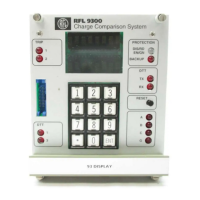
When the voltage is applied, the DTT TX, DTT RX, and DTT 1 indicators should
light on the 93B DISPLAY module.
3. Disconnect the dc voltage source from the DTT-IN terminals.
When the voltage is removed, the DTT TX indicator on the 93B DISPLAY module
will remain lit until its RESET switch is pressed. The output relay will remain
latched until the DTT-1 trip circuit current is interrupted and a DTT signal has not
been received for 100 ms. The DTT RX and DTT 1 indicators will remain lit until
the relay is unlatched and the RESET switch is pressed.
4. Watch the display on the 93A DISPLAY module.
If the current through the trip contacts is not interrupted within 500 ms, the mes-
sage "ALARM 24" will appear on the display. This means that the lockout relay
(Device 86) is defective.
5. Repeat steps 2 through 4 with the trip contacts unloaded.
The DTT 1 indicator will not light, because no trip current was sensed. The DTT
tripping relay will remain energized until 100 ms has elapsed since the last DTT
signal was received. This can be verified with an oscilloscope.


 To Next Page