2.7.5 ULTRA HIGH-SPEED TRIP (UHST) ALGORITHM
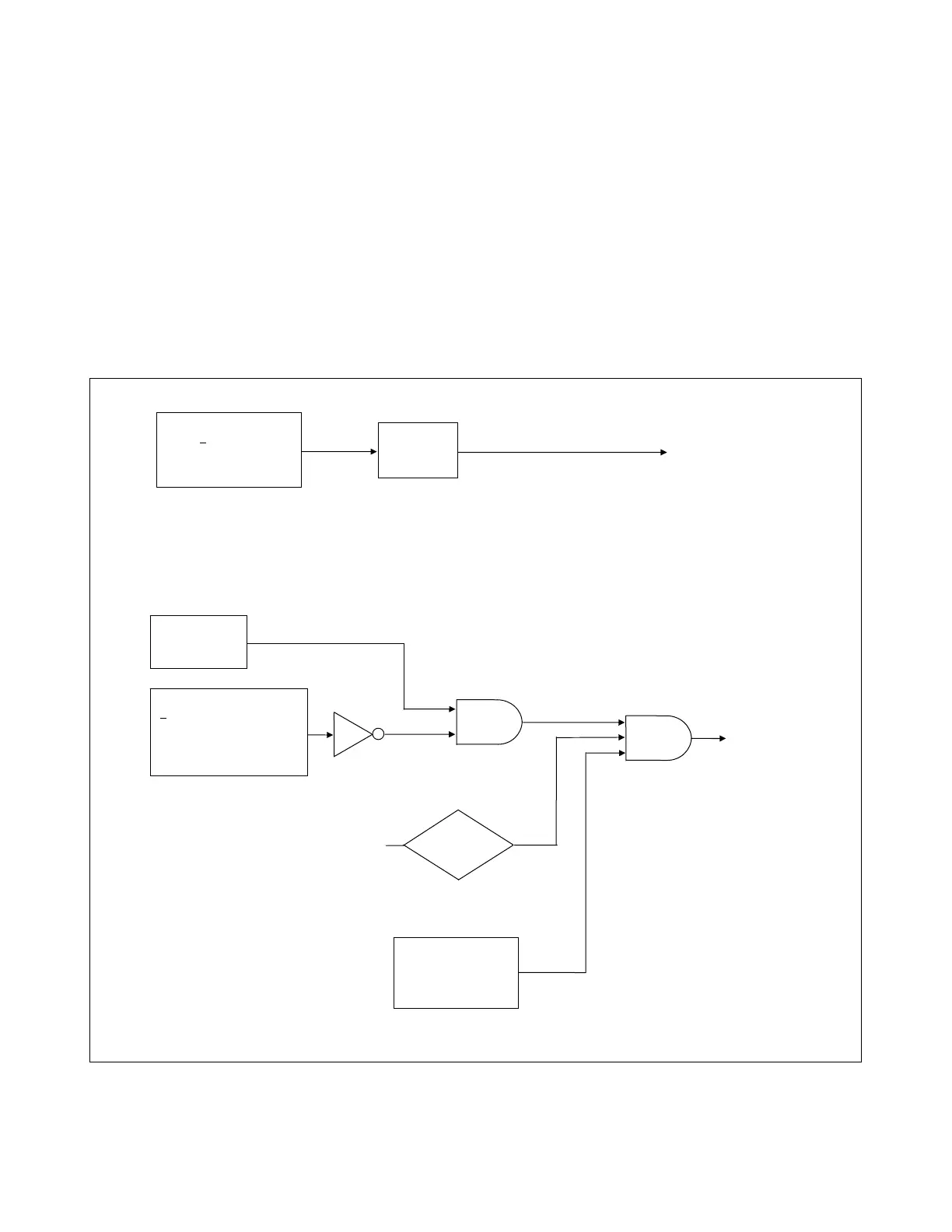
The UHST algorithm is a blocking algorithm that allows a trip at the remote station if a blocking current equal to
- (11A - bias setting)
peak
has not been recorded (See Figure 2-7). The minimum blocking current allowed is
- 7.5A peak. The RFL 9300 sends a UHST signal to the remote RFL 9300 whenever the local station detects
that the input current's peak value is +12 amperes or more for 2 ms. This results in a much faster trip response
at the remote RFL 9300 for strong internal faults, since it doesn't have to wait for the current waveform's zero
crossing to send the signal.
For the ground subsystem, the blocking current is + (11A - bias setting)
peak
and the input current's peak value
is –12 amperes or more for 2 ms. The minimum blocking current allowed is +7.5A peak.
For examples of UHST operation, see Figures 3-11 and 3-12 in Section 3 of this manual.
a. Transmitting terminal
Note: For 3- terminal systems, UHS must be validated by CCD, WCM or UHS from remaining terminal.
b. Receiving terminal
AND
AND
TRIP
AND SEND
CCT-U TO
REMOTE
TERMINAL
LOCAL BLOCKING SIGNAL
> (11A-BIAS SETTING) peak
OVER APPROPRIATE
TIME WINDOW
(NEGATIVE FOR PHASE
POSITIVE FOR GROUND
UHS MESSAGE
TO REMOTE
TERMINAL
LOCAL CURRENT
>12A PEAK
FOR 2ms
(POSITIVE FOR PHASE
NEGATIVE FOR GROUND
RECEIVED UHS
TRIP
ENABLED
NO
YES
?
LOCAL
FAULT DETECTOR
FOR PHASE
IN QUESTION
TX
Figure 2-7. Logic diagram, ultra high-speed trip
RFL 9300 RFL Electronics Inc.
October 29, 2001 2 - 20 (973) 334-3100


 To Next Page