3.16 OPEN CONDUCTOR WITHOUT SINGLE LINE-TO-GROUND
FAULT
Occasionally, an open conductor may occur that does not involve any ground fault at all. For example, this could
happen at a direction-changing tower, where the break occurs in the short conductor between strain insulators.
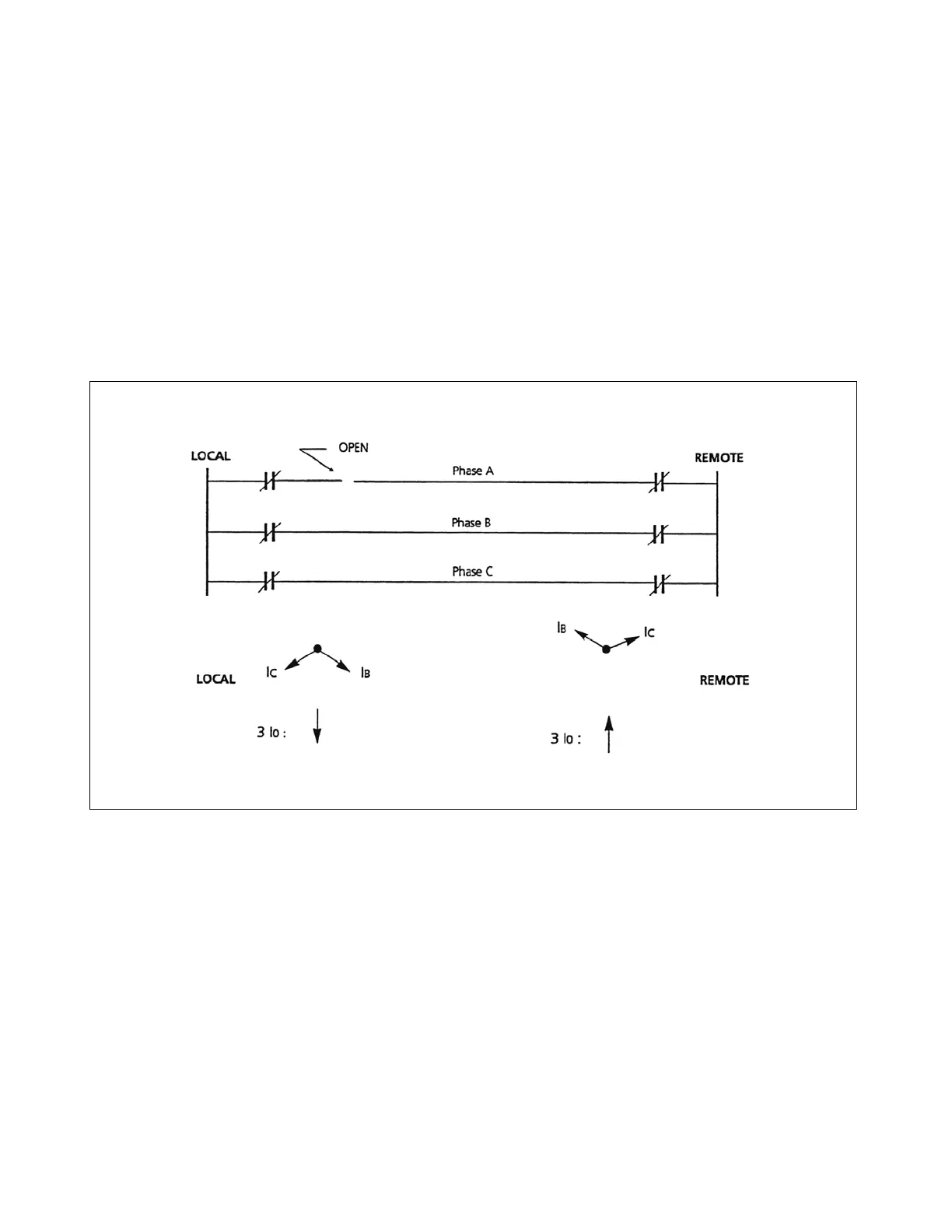
This would produce the condition shown in Figure 3-26.
If there is no load flow between the local and remote terminals before the conductor opens, there is no way to
detect an open circuit. This is because basic electric circuit theory states that a wire that is not carrying current
may be replaced by an open circuit. But if the transmission line is carrying load current before the conductor
opens, the open circuit will create the phasors shown in Figure 3-26. Since the phasors do not violate Kirchhoff's
Laws or the Principle of Conservation of Charge, the RFL 9300 does not create a trip signal.
Figure 3-26. Open conductor without single-line-to-ground fault
On the other hand, the condition in Figure 3-26 does look like an internal BC-G fault where the remote breaker
has tripped. In other words, it looks like a loss-of-load condition. The loss-of-load circuit can detect the open con-
ductor condition. To provide security, the loss-of-load circuit requires a "Zone 2" timer before tripping or alarming
takes place. The timer is usually set to about 150 ms, and the choice between tripping or alarming is made by
the user. The Zone 2 timer prevents other conditions that can masquerade as an open-conductor from creating a
false trip signal.
RFL 9300 RFL Electronics Inc.
August 25, 2000 3 - 29 (973) 334-3100


 To Next Page