RFL 9300 RFL Electronics Inc.
October 29, 2001 2 - 26 (973) 334-3100
2.8.2 OVERCURRENT ALGORITHM
This is strictly a fuse type of protection. Instead of instantaneous peak readings, half-cycle integral values are
used to determine if the overcurrent setting has been exceeded. The overcurrent setting is programmed by the
operator through the keypad. There is a separate setting for the phase overcurrent (A/B/C) backup and the
ground overcurrent backup.
2.8.3 LOSS-OF-LOAD ALGORITHM
In the loss-of-load protection algorithm (Figure 2-8), the controller looks for a loss of load on one phase while
one or both remaining phases carry a strong load current (greater than 3 amperes). It also looks for a loss of
load on two phases while the third carries a strong load current (greater than 3 amperes). These conditions sug-
gest that the remote breaker has opened, but since one or more phases is carrying strong current, there is an
internal fault. The phase (A, B, C) currents must be ≥ 1.5 A to enable the loss-of-load algorithm.
The loss of load function allows sequential tripping in situations where communications may still be established
in one direction. If an internal fault condition exists and the breaker at the remote station opens, phase current in
the faulted phase(s) will remain high. The phase current on the unfaulted phase(s) will fall to line charging lev-
els. The remote station could then trip through a CCD message received from the local station. The local station
would trip on loss-of-load after the remote breaker opens.
2.9 DIRECT TRANSFER TRIP (DTT)
When the DTT initiate signal is asserted, the transmitting terminal sends ten consecutive DTT words. This is
followed by a refresh of two DTT words every 40 milliseconds. The DTT refresh pattern continues as long as
the DTT initiate signal remains active.
At the receiver terminal, two consecutive received DTT words are required to qualify the signal. Once qualified,
a single received DTT word will keep the signal active. A 100 ms drop-out timer at the receiver terminal bridges
over the holes in the refresh pattern. DTT trip release at the receiver terminal will be delayed until DTT trip coil
current is no longer sensed and there has not been a DTT signal received for 100 ms.
2.10 DISPLAY CONTROLLER
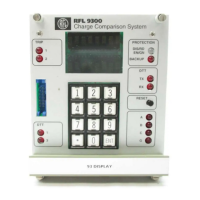
The display controller has a 15-character display and a keypad for operator interface, and an RS-232 serial
port. It monitors and enables the trip signals. (See Section 5 for instructions.)
By using the display and keypad, the operator can modify the protection algorithms executed by the phase con-
trollers to meet system requirements. These variables are stored in non-volatile memory on the display control-
ler. The "official" copy of these variables is stored in non-volatile memory on the RFL 93B SV. The 15-character
display is used for alarm annunciation and to display many other system parameters. (A complete list of pro-
grammable parameters appears in Section 6 of this manual.)
The display controller is connected to the RFL 93B SV through a RS-485 serial link. A serial link to external
equipment is provided through the RS-232 port located on the RFL 93B RELAY I/O assembly. This port is also
controlled by the display controller. The microcontroller on the display controller has only one serial port that
must be shared between these two serial links.
If any system or communications alarms are active, the RFL 93B SV will signal the display controller. Each
alarm message has an error number that appears on the display. The display controller monitors the trip sig-
nals; it generates alarm messages if any error conditions are detected.


 To Next Page