RFL 9300 RFL Electronics Inc.
October 29, 2001 2 - 27 (973) 334-3100
The display controller also monitors the outputs of the Contact Current Sense circuits. It will light the appropriate
indicator on the Display Module whenever it senses contact current. The status of all front panel indicators (ex-
cept the two-color PROTECTION EN/DIS indicator) are saved in non-volatile memory. If the RFL 9300 is turned
off or loses power for any reason, these indicators will reflect their previous status when power is restored.
When a phase controller trip signal is detected, the output trip relay is latched. The phase controller will continue
to apply the trip signal until either of the events listed below occurs, whether or not the fault detectors remain
active.
1. A breaker-open signal is received from the Supervisor.
2. A breaker-open signal has not been received from the Supervisor and 200ms has passed since the
fault condition was last detected.
The display controller will utilize the trip release algorithm selected by the operator (parameter #145) to unlatch
the trip relay. Three methods are available for unlatching the trip relay:
1. Output trip will unlatch without delay when both the internal trip and DC trip current sense signals
are no longer active.
2. Output trip will be unlatched 100ms after the internal trip signal is no longer active.
3. Output trip will be released with 0ms delay when the internal trip signal becomes inactive.
(Note that the internal trip signals are supplied by the Phase Controllers)
It is very useful for diagnostic purposes, to know which algorithm calculated the trip signal. Sequence of Events
data, available via the RS-232 port, includes this fault algorithm information (See Figure 2-11)
If the dc current flowing through the trip contacts is > 0.1 Amp dc and lasts for more than 500 ms, ALARM No.
27 operates, indicating a breaker failure or interposing relay failure.
If the dc current level is not detected, there is no alarm, and the TRIP LED(s) do not operate, however the
A/B/C/G targets still operate. The breaker trip indication would now have to come from the interposing tripping
device, if one is used.
When a DTT trip signal is detected, the DTT trip relay is latched. The display controller will unlatch the trip relay
100ms after the DTT trip signal is no longer detected so long as there is no current flowing through the trip con-
tacts.
If the dc current level (now 0.1A) is not sensed, there is no alarm. If the current is sensed for more than 500 ms,
ALARM No. 24 is operated. This indicates a failure of the lockout relay (Device 86), interposing tripping relay
(Device 94), or circuit breaker (Device 52), which should be operated by the 9300 output relay contact and
should interrupt the dc current in the DTT output contact.
If dc current flowing through the trip contacts is detected for an interval exceeding 60ms and a trip signal has not
been issued, ALARM No. 25 operates, indicating a trip relay contact failure or current sense circuit failure.
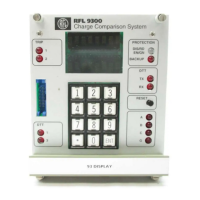
The RESET switch on the front of the Display Assembly serves a dual purpose. When it is pressed, as long as
there are no active trip signals, all LED status indicators on both the Display and Single-Pole Assemblies will be
reset and a 3-second LED test will be triggered on both. After the LED test is completed, the remaining modules
except for the comms cards in the RFL 9300 will execute a 3-second LED test. If there are any active trip sig-
nals on the main chassis, a “TRIP ACTIVE” message will appear on the display and the reset signal will have no
effect. Even if there are active trip signals detected on the main chassis the reset signal will still be transmitted
to the Single-Pole logic where LED status indicators will be reset only on unfaulted phases without active trip
signals. The RESET switch is also used to reset any alarms generated by the Display Controller. Alarms trans-
mitted to the Display Controller by the RFL 93B SV and the Single-Pole logic will not be reset when the RESET
switch is pressed. These alarms will only be reset when the alarm condition itself disappears.


 To Next Page