3.14 TAPPED LOAD
Tapped load applications are a concern for all line protection schemes. Sometimes it is easier to apply distance
relays to a tapped line, because the forward-looking relays can sometimes be set "into the bank" without affect-
ing line coverage. In other cases, the application of current differential (or charge comparison) relays is easier.
This is particularly true when the tap is near one terminal on a medium-length or long line. The response of the
current differential system is based on total
fault current. In contrast, the distance relays respond to local infor-
mation only and the distance relays must create a correct trip/no-trip decision at both terminals in permissive
schemes.
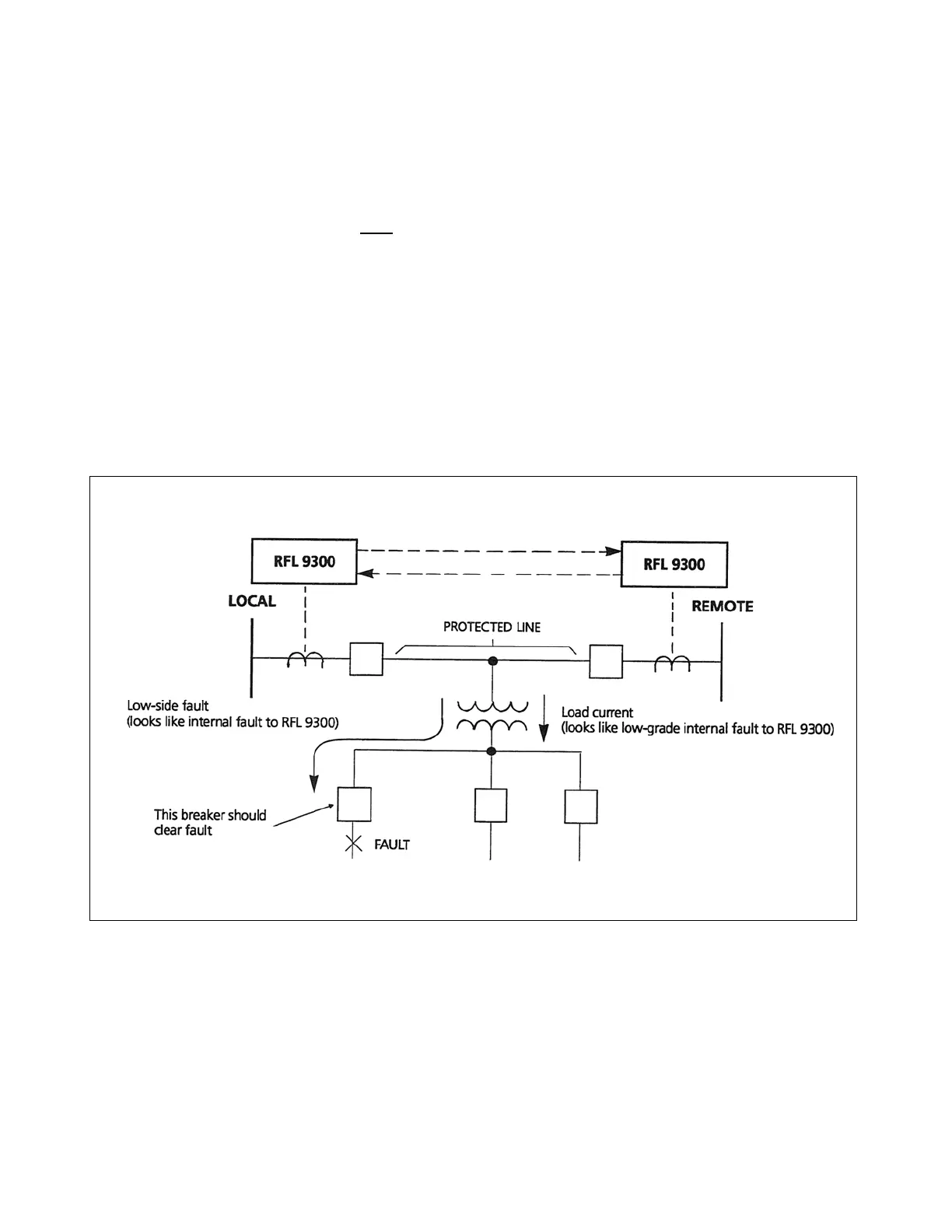
A typical tapped-line application is shown in Figure 3-18. Applications such as this present three problems to
the RFL 9300:
1. The load current looks like a low-grade internal fault.
2. Low-side faults look like medium-grade internal faults.
3. Transformer in-rush looks like a low-grade internal fault, particularly when the transformer is energized
by closing a high-side disconnect switch at the tap. If the transformer is energized by closing a circuit
breaker, the bias control function provides security. (See Figure 3-19.)
Figure 3-18. Typical tapped line application
The problem of handling low-side faults is much more severe than that of load current, because transformer
impedance is typically 6 to 10percent. This means that low-side phase faults are at least ten times the magni-
tude of the rated current. The RFL 9300 can be applied to tapped lines by raising the bias level so that the RFL
9300 will not respond to low-side faults. At the same time, the RFL 9300 will still see all internal faults on the
protected line.
RFL 9300 RFL Electronics Inc.
August 25, 2000 3 - 20 (973) 334-3100


 To Next Page