RFL 9300 RFL Electronics Inc.
August 9, 2001 9 - 9 (973) 334-3100
OSCILLOGRAPHY DATA
A four channel 8-bit analog to digital converter, U119 is used to convert the analog current information into a
digital format. The input signals pass through a first order low pass filter and a voltage clamping circuit for noise
filtering and U119 for input protection. ADC U119 samples all inputs simultaneously, and then converts the data
in sequence. The results are read out by U125 after all conversions have been completed. The -5 volt power for
U119 is generated from the -15 volt supply by linear voltage regulator U118.
BUZZER
When the /BUZZER signal at edge connector terminal P1-A8 goes low, transistors Q101 and Q102 turn on. This
provides drive voltage for audible sounder SP101. SP101 is normally turned on and off intermittently by the mi-
crocontroller on the display controller.
9.4 FRONT PANEL
For the following discussion refer to Figure 9-7, sheet 3.
9.4.1 THEORY OF OPERATION
DISPLAY
The front panel contains an alphanumeric display that is under the control of the microcontroller on the display
controller.
Buffer/line drivers U201 and U204 accept the data and address buses from the display controller. De-
coder/demultiplexer U205 decodes the STROBEA0 and STROBEA1 inputs, A6 and A7 from the microcontroller.
It uses these inputs to select either the U202 display or the U203 display, to reset both displays, or to enable the
keypad. U205 is enabled by the STROBE input going low. This is the microcontroller's I/O port 2.5.
The FLASH input (A5) from the microcontroller goes to transistor Q206. Jumper J202 can be used to invert the
FLASH signal. J202 must be in Position B (non-inverting) if Hewlett-Packard displays are used. If Siemens dis-
plays are used, J202 must be in Position A (inverting).
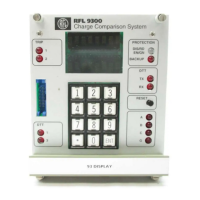
KEYPAD
The front panel also has a keypad for user entries. When STROBEA0 and STROBEA1 are both high and
STROBE is low, U205-7 is made low. This enables the strobing of the keypad. The A0 and A1 lines from the mi-
crocontroller scan each column in the keypad. For example, when both A0 and A1 are low, U205-12 will be low.
This will turn on the transistor connected to it. RZ201-10 will be low, placing a low on the first keypad column (pin
K). If any key on this column is pressed, one or more of the KEY0 through KEY3 lines will be made low. This
allows the microcontroller to determine which keys are pressed. The KEY0 through KEY3 lines are connected to
pull-up resistors on the display controller. If the keypad column is made low but no key is pressed, the KEY0
through KEY3 lines will all be high. The microcontroller continuously scans all the columns on the keypad look-
ing for pressed keys.


 To Next Page