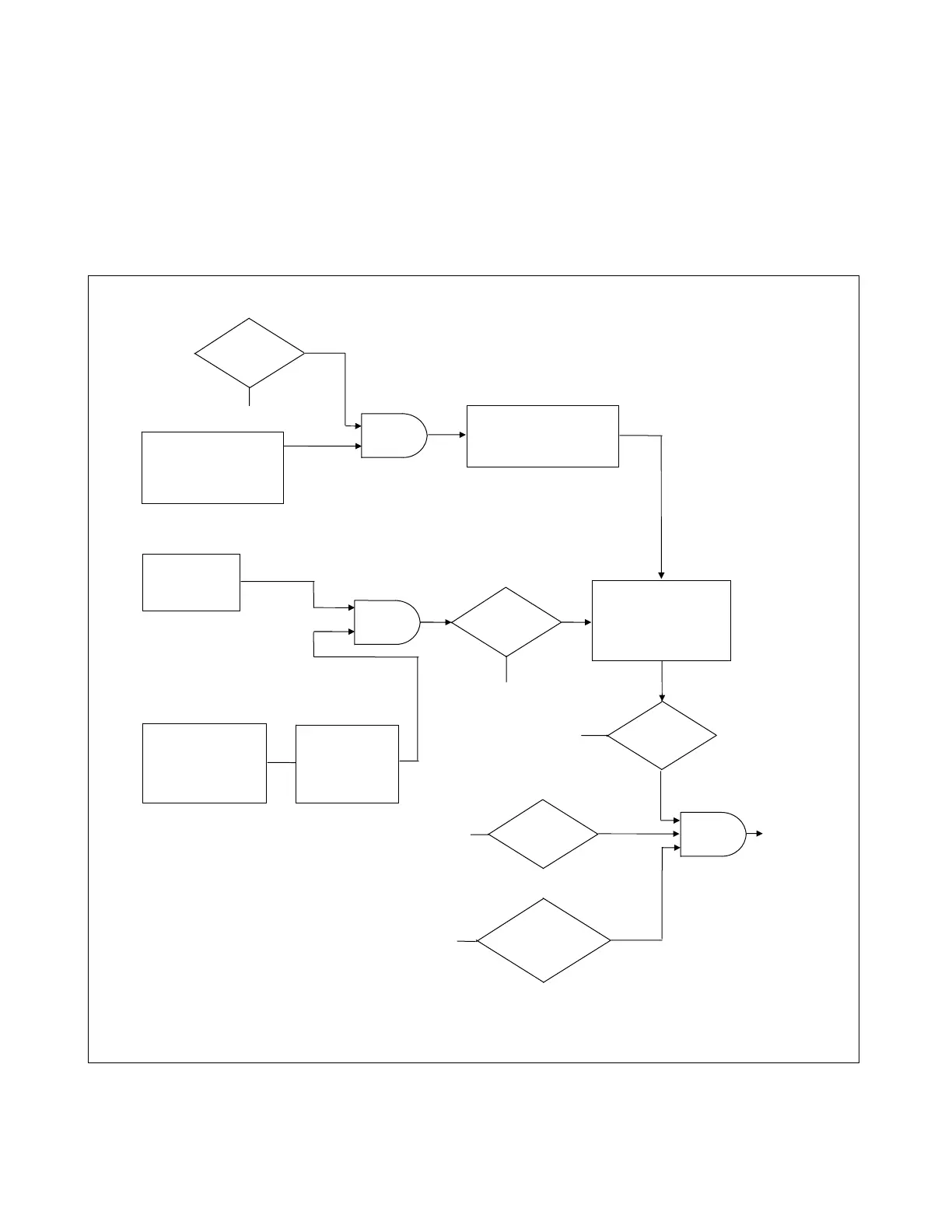
2.7.4 SWITCH-INTO-FAULT (SIF) ALGORITHM WITH COMMUNICATIONS
The RFL 93B PC modules will begin sending weak-current messages (WCMs) to the remote terminals after the
breaker opens (2-Terminal systems) or transient CT control current (3-terminal systems) drops below 0.5A rms
for 8ms. (See the description of the WCM in paragraph 2.7.1). If the breaker is open WCMs will be transmitted
to the remote terminals at approximately 2ms intervals. The SIF algorithm provides a fast trip at any station that
closes its main breaker into a fault (See Figure 2-6). After a WCM message is received (validated WCM mes-
sage in the case of a 3-terminal system) the RFL 9300 uses a special formula to adjust its time-tag. From that
point on it is treated as a CCD message with zero value and run through the SFT algorithm.
AND
AND
COMPOSITE
FAULT DETECTOR?
(SEE FIG. 2-2)
AND
BIAS CONTROL TIME
WINDOW STARTS WHEN
BREAKER CLOSED
SIGNAL RECEIVED
FROM SUPERVISOR
INCREASE BIAS LEVEL
(+3A FOR UNDERGROUND,
+1.5A FOR OVERHEAD
TRANSMISSION LINES
WCM RECEIVED
FROM REMOTE
TERMINAL
A/D CONVERSION
AND CALCULATION
OF TRUE CT
CONTROL CURRENT
1/2 CYCLE CHARGE
LOCAL CCD
WORD STORED
IN CHARGE
COMPARISON
BUFFER
BIAS CONTROL
ENABLED
?
YES
NO
CALCULATE SCALAR
SUM, ARITHMETIC
SUM & % DIFFERENTIAL
BIAS LEVEL
(SEE FIG. 2-4A)
REMOTE VALUE
NEST
?
ARITHMETIC
SUM>BIAS
LEVEL?
TRIP
ENABLED
?
NO
YES
NO
YES
NO
YES
NO
YES
TRIP AND
SEND CCT-U
TO TREMOTE
TERMINAL
NOTE 1
NOTE 2
NOTES: 1. WCM MUST BE VALIDATED FOR THREE TERMINAL SYSTEM.
2. BOTH REMOTE VALUES MUST NEST FOR THREE TERMINAL SYSTEM.
Figure 2-6. Logic diagram, switch-into-fault with communications (2- and 3- terminal systems)
RFL 9300 RFL Electronics Inc.
October 29, 2001 2 - 19 (973) 334-3100


 To Next Page