RFL 9300 RFL Electronics Inc.
October 20, 2004 8 - 21 (973) 334-3100
8.3.4 SHORT HAUL FIBER COMMUNICATIONS
The following procedure verifies end-to-end communications for RFL 9300 relays equipped with short haul fiber
modules. No additional equipment is required to perform this procedure.
1. Make sure the connections between the RFL 9300 and the (FSU) fiber service unit have been
properly made.
The transmit fiber should be connected from the TX connector on the short haul
fiber interface module to the RCV connector on the fiber service unit. The receive
fiber should be connected from the RX connector on the short haul fiber interface
module to the TX connector on the fiber service unit. The RS-449 cable should be
connected from the fiber service unit to the external equipment.
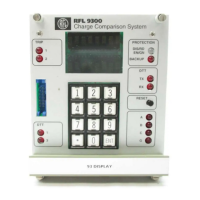
2. Using the RFL 9300's READ display mode, check the channel delay time by watching the ping-
pong value displayed on the bottom line of the display.
For short lines, the ping-pong value should be 4.0 or 4.5 ms. For very long lines
or lines with many repeaters, this delay can be about 6 ms. (The RFL 9300 can
tolerate channel delays as large as 31 ms.)
3. Place the RFL 9300 back in the STANDBY display mode.
The display will return to the moving dot pattern.
Short haul fiber communications have now been verified. Go on to the next procedure.
8.3.5 G.703 COMMUNICATIONS
The following procedure verifies end-to-end communications for RFL 9300 relays equipped with G.703 mod-
ules.
No additional equipment is required to perform this procedure.
1. Make sure the connections between the RFL 9300 and the external equipment have been prop-
erly made.
A shielded, two-pair, four conductor cable with a 15-pin D-subminiature connec-
tor should be connected from the G.703 module on the rear panel of the RFL 9300
to the external equipment. This cable must be wired according to the G.703 sig-
nal list in Section 23 of this manual.
2. Check the settings of jumpers J2, J3 and J5.
J2 should be in position A for normal operation.
J3 should be set for a 56kbps or 64kbps data rate.
J5 should be in the NORM position for normal operation.
3. Using the RFL 9300's READ display mode, check the channel delay time by watching the ping-
pong value displayed on the bottom line of the display.
For short lines, the ping-pong value should be 4.0 or 4.5 ms. For very long lines
or lines with many repeaters, this delay can be about 6 ms. (The RFL 9300 can
tolerate channel delays as large as 31 ms.)
4. Place the RFL 9300 back in the STANDBY display mode.
The display will return to the moving dot pattern.
G.703 communications have now been verified. Go on to the next procedure.


 To Next Page