The best method of calculating a low-side, three-phase fault (worst-case) is to first calculate the rated load cur-
rent. This is based on the MVA rating of the transformer:
MVA = 3 x I
L
x V
LN
For the system shown in Figure 3-21, the calculation would be as follows:
20 x 10
6
= 3 x I
L
x 80,000
∴ I
L
= 20,000 / 240 = 83.3 amperes
(0.175 secondary amperes)
Since the impedance of a 138-kV transformer is usually 10 to 15 percent, the worst-case value (10 percent) is
assumed for the calculations. The following formula is used to calculate the three-phase fault current (I
F
):
I
F
= 1 / 10 percent x I
L
= 10 x I
L
= 10 x 83.3 amperes
= 833 amperes
(1.75 secondary amperes)
Although this is a high "false differential" current, it is only about one-eighteenth the magnitude of the high-side
fault current (31.25 secondary amperes). Since there is an 18:1 ratio between the minimum internal phase cur-
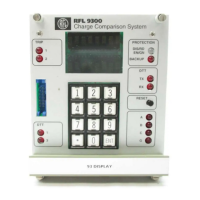
rent and the maximum external fault phase current, there is plenty of room to apply the RFL 9300. To do this,
the correct phase bias level must be set.
The ground bias level may be set at minimum (1.0 secondary amperes), since 3I
0
will not flow through the
delta-wye transformer to feed low-side ground faults. The maximum phase bias setting available in the RFL
9300 is 8 amperes. Low-side phase faults cause a maximum "false differential" of 1.75 amperes, as calculated
above. The phase bias should be set to a value equal to at least three times the maximum let-through current;
this will take care of transient over-reach due to dc offset. With the phase bias set at 6 amperes, the RFL 9300
can tolerate a let-through current of 2 amperes, so a setting of 6A phase bias is appropriate for this application.
The final step is to verify that a 6-ampere phase bias setting will allow the RFL 9300 to sense all internal phase
faults. At a 2400:5 ratio, the minimum high-side fault current for a three-phase fault was calculated to be 31.25
secondary amperes. For a phase-phase fault, this figure would be
√3 / 2 x 31.25 A = 27.05 secondary amperes
Since this value is well above the phase bias setting of 6 amperes, it does not compromise RFL 9300 sensitivity.
3.14.2 TRANSFORMER IN-RUSH
The worst-case in-rush is caused by closure of the high-side disconnect switch at the tap. (See Figure 3-19b.)
This is worst-case because the RFL 9300's at both ends of the protected line have no knowledge of the discon-
nect switch closure, and cannot introduce temporary desensitizing of the bias level (called "bias control").
RFL 9300 RFL Electronics Inc.
August 25, 2000 3 - 23 (973) 334-3100


 To Next Page