2.37
Date Code 20171021 Instruction Manual SEL-421 Relay
Installation
Connection
Program OUT108 to respond to NOT HALARM by entering the following
SEL
OGIC control equation with a communications terminal in QuickSet:
OUT108 := NOT HALARM
When the relay is operating normally, the NOT HALARM signal is at logical 1
and the b contacts of control output OUT108 are open.
When a status warning condition occurs, the relay pulses the NOT HALARM
signal to logical 0 and the b contacts of OUT108 close momentarily to indicate
an alarm condition.
For a status failure, the relay disables all control outputs and the OUT108 b con-
tacts close to trigger an alarm. Also, when relay power is off, the OUT108 b con-
tacts close to generate a power-off alarm. See Relay Self-Tests on page 10.15 in
the SEL-400 Series Relays Instruction Manual for information on relay self-tests.
The relay pulses the SALARM Relay Word bit for software programmed condi-
tions; these conditions include settings changes, access-level changes, and alarm-
ing after three unsuccessful password entry attempts.
The SEL-421 also pulses the BADPASS Relay Word bit after three unsuccessful
password entry attempts.
You can add the software alarm SALARM to the alarm output by entering the
following SEL
OGIC control equation:
OUT108 := NOT (HALARM OR SALARM)
Tripping and Closing Outputs
To assign the control outputs for tripping and closing, see Setting Outputs for
Tripping and Closing on page 3.67 in the SEL-400 Series Relays Instruction
Manual. In addition, you can use the SET O command (see Output Settings on
page 8.35 for more details). You can also use the front panel to set and verify
operation of the outputs (see Set/Show on page 4.25 in the SEL-400 Series Relays
Instruction Manual).
Auxiliary TRIP/CLOSE Pushbuttons and OPEN/CLOSED LEDs
(Select Models Only)
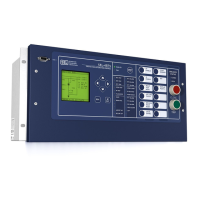
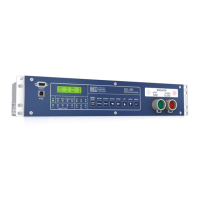
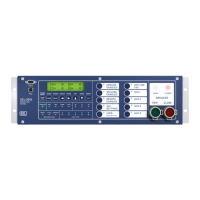
Select relay models feature auxiliary TRIP and CLOSE pushbuttons and OPEN and
CLOSED LED indicators. These features are electrically isolated from the rest of
the relay. They function independently from the relay and do not need relay
power.
The pushbuttons and LEDs can be hard-wired into a substation trip and close
control circuit and operate the same as a separate installation of external
trip/close switches and LED indicators. Figure 2.57 shows example trip and close
circuit connections for a control scheme configuration with a dc substation volt-
age source. The pushbutton switches come set from the factory for dc operation
(arc suppression enabled). To use an ac trip or close potential, the arc suppression
must be disabled for one or both pushbuttons (see Table 2. 9 ). The voltage operat-
ing ranges of the LEDs are selected by jumpers (see Table 2.8 ).
Because the TRIP and CLOSE pushbuttons are functionally separate from the relay,
a manual trip or close cannot be distinguished from an external protection or
automation-initiated operation. Unless provisions are made in the control wiring,
the action of the close pushbutton is unsupervised.
SEL-421 features such as Hot Line Tag
and Synchronism Check do not super-
vise the auxiliary close pushbutton.


 To Next Page