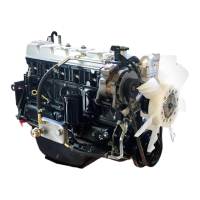
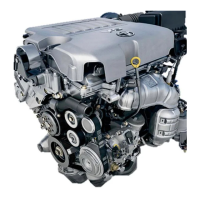
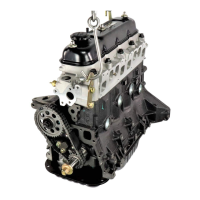
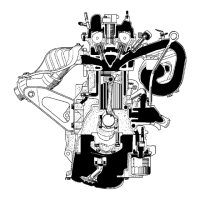
The 3VZ–E engine has 6–cylinders in a V arrangement at a bank angle of 60. From the front
of the right bank the cylinders are numbered 1 – 3 – 5, and from the front of the left bank the
cylinders are numbered 2 – 4 – 6.
The crankshaft is supported by 4 bearings inside the crankcase. The bearings are made of
aluminum alloy.
The crankshaft is integrated with 5 weights which are cast with it for balance. There are oil holes
in the center of the crankshaft to supply oil to the connecting rods and bearings, etc.
The firing order is 1 – 2 – 3 – 4 – 5 – 6. The cylinder head is made of aluminum alloy, with
a cross flow type intake and exhaust layout, and semi–heron type combustion chambers.
At the front and rear of the intake port of the intake manifold, a water passage has been provided
which connects the left and right cylinder heads.
Each intake exhaust valve is equipped with irregular pitch springs made of special valve spring
carbon steel which are capable of following no matter what the engine speed.
The left and right camshafts are driven by a single timing belt. The cam journal is supported at 5
places, between the valve lifters of each cylinder and on the front end of the cylinder head.
The cam journal and the cam are lubricated by oil supplied through the oiler port in the center of
the camshaft.
Adjustment of the valve clearance is done by means of an outer shim type system with the valve
adjusting shims located above the valve lifters so that the shims can be replaced without
removing the camshafts.
The timing belt cover is composed of the resin type No.1 and No.2 above and below the fan
bracket, and the No.3 and No.4, which are made of steel sheet to make removal of the intake
manifold easier.
The pistons are made of high temperature resistant aluminum alloy, and the piston head is
concaved to prevent interference with the valves.
The piston pins are the semi–floating type, with the connecting rods and pins pressure fitted so
that the piston and pin float.
The No. 1 compression ring is made of stainless steel and the No.2 compression ring is made of
cast iron. The oil ring is made of a combination of steel and stainless steel. The outer diameter of
each piston ring is slightly larger than the diameter of the piston, and when the piston ring is
attached to the cylinder, the expansion of the piston ring produces a close fit with the cylinder
walls.
The No.1 and No.2 compression rings work to prevent gas leakage, and the oil ring works to
scrape oil off the cylinders and prevent it from entering the combustion chambers.
The cylinder block is made of cast iron with a bank angle of 60. It has 6 cylinders which are
approximately twice the length of the piston stroke. The top of each cylinder is closed off by the
cylinder head and the lower end becomes the crankcase where the crankshaft is installed. In
addition, the cylinder block contains a water jacket to cool the cylinders.
The oil pan is bolted onto the bottom of the cylinder block. The oil pan is an oil reservoir made of
pressed steel sheet. A baffle plate has been installed between the oil pan and cylinder block to
reduce oil stir from the crankshaft and connecting rod.
Plastic region tighten bolts are used for the cylinder head, main bearing cap and connecting rod.
–ENGINE ENGINE MECHANICAL
EG2–3


 To Next Page